Dog Bed Sizes: How to Measure Your Dog

"Small," "medium" and "large" are not standard sizes. One shop's large is another's medium, and the same label can cover a 20 cm range. The only reliable way to buy the right bed is to measure the dog and compare against the centimetres printed on the product page.
It takes two minutes and it is the one decision that cannot be corrected afterwards.
Measuring the dog
Wait until the dog is already lying down in its normal sleeping position. Do not stand it up and measure it — a standing dog gives you the wrong number.
Length. Measure along the body from the tip of the nose to the base of the tail. If the dog sleeps with its legs stretched out, measure to the end of the extended front paws instead. Take the longer of the two.
Width. Measure across the widest point of the dog while it is lying down — usually the shoulder or the hip, depending on the position.
Then add 15 to 20 cm to each figure. That margin is what lets the dog shift position without a leg going over the edge.
If your dog has more than one sleeping position — curled by the radiator, stretched flat by the door — measure the stretched one. A bed that fits the flat position also fits the curled one. The reverse is not true.
Internal versus external dimensions
This is where most sizing mistakes come from.
The measurements we list for every bed we stock are external unless the page says otherwise. External means the outside footprint, including any raised edge.
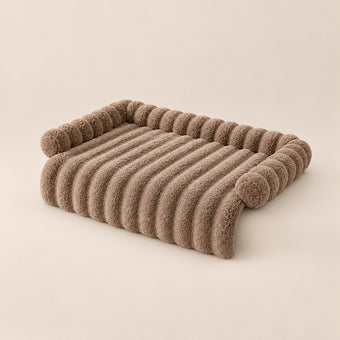
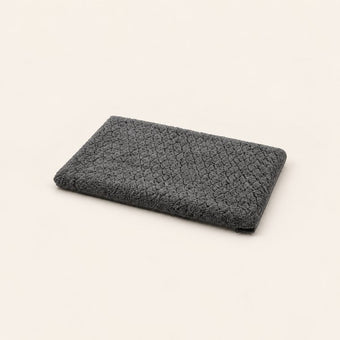
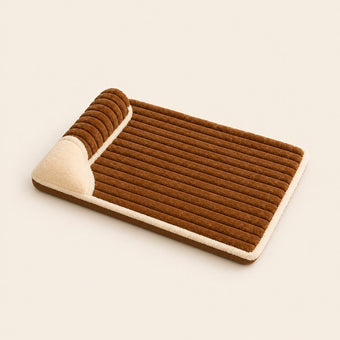
On a flat mat, external and internal are the same. On a bed with a rim, the rim can take 10 to 15 cm off each side, which means a bed described as 100 cm long may have 70 cm of flat surface. For a dog that needs 85 cm, that bed is too small even though the number on the page is larger.
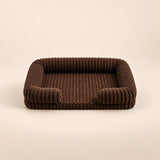
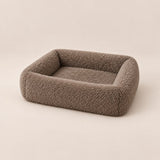
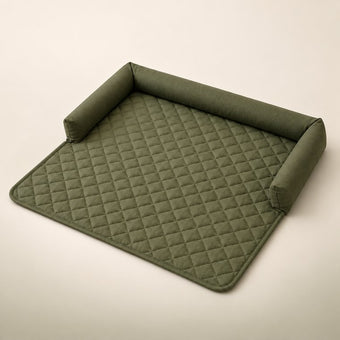
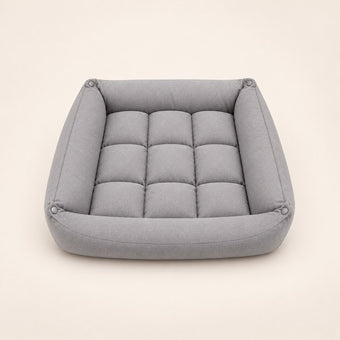
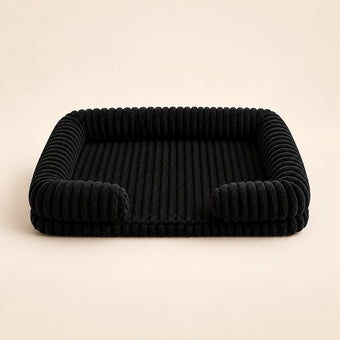
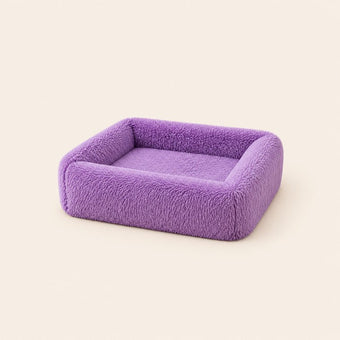
Raised edges eat into the flat area, so beds built like a small couch need a size up.
If you are choosing a bed with a raised rim, measure the inside, not the outside.
A rough size ladder
These are the bands we use internally. They are a starting point for narrowing a list, not a substitute for measuring your own dog.
| dog's lying length | minimum internal bed length | typical label |
|---|---|---|
| up to 45 cm | 60 cm | small |
| 45–60 cm | 75 cm | medium |
| 60–75 cm | 90 cm | large |
| 75–95 cm | 110 cm | extra large |
| over 95 cm | 120 cm and up | giant / oversized |
Above 90 cm of sleeping length you are into the large sizes.
Past a certain weight the fill matters as much as the footprint, and dog beds for large dogs have their own list.
How to size a crate bed
Crates are the exception: the bed is sized to the crate, not the dog.
Measure the crate's pan — the tray at the bottom — from inside edge to inside edge. Do not measure the outside of the frame; the difference is usually 2 to 4 cm and it is enough to stop a pad from lying flat.
Crate pans are measured inside the frame, so crate beds are measured differently.
A crate pad should sit flat with no curl at the edges. A pad that is slightly too big rides up the sides, and the dog ends up sleeping on a ridge.
Puppy dog bed sizes: buy the adult size
A puppy will outgrow a puppy-sized bed within months. There are two sensible approaches and one that wastes money.
Buy the adult size straight away and accept that it looks oversized for a while. Most puppies have no problem with a bed that is too big. Or buy one cheap, washable pad for the chewing and toilet-training months, then buy the real bed once that phase is over.
What does not work is buying three beds in eighteen months because each one was sized for the dog in front of you.
If you do not know the adult size, look up the breed's typical adult length rather than weight — bed sizes are driven by length, and two dogs of the same weight can be very different shapes.
What to do when the dog is between sizes
Go up.
A bed that is slightly too big costs floor space. A bed that is slightly too small costs the dog somewhere to put its head, and it will start sleeping half off the bed — which is the most common sign of a size problem, and easy to misread as the dog not liking the bed.
After size
Size is the first filter; our general buying guide covers the rest — fill, cover, base and shape, in the order they matter.