Best Dog Crate Beds

A crate bed is not a small room bed. It sits inside a fixed rectangle, gets washed far more often than any other bedding in the house, and has to stay flat with no edges riding up. Those three constraints rule out most of what works elsewhere.
If the crate is for a puppy, our crate training schedule for a puppy gives the time limit for each age.
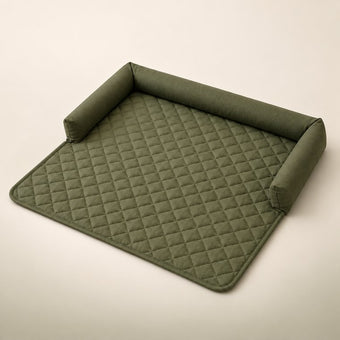
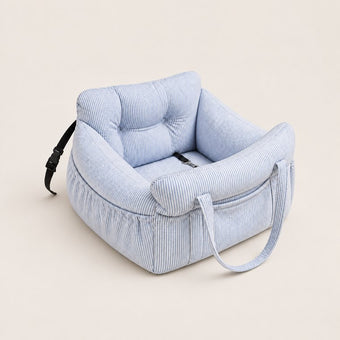
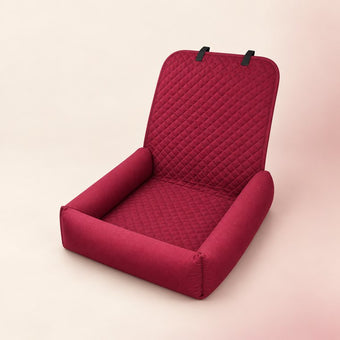
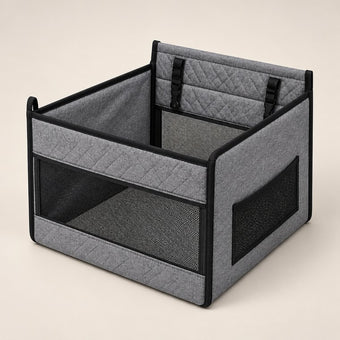
The crate and travel beds we stock are listed by the crate size they fit.
How to measure a crate pan for a bed
The most common mistake, and the easiest to avoid.
Crate dimensions are quoted from the outside of the frame. The pan — the tray in the bottom — is smaller, usually by 2 to 4 cm on each dimension because of the frame thickness and the lip around the tray edge.
Measure the pan from inside edge to inside edge, and buy a pad that matches or is 1 cm smaller. A pad that is 3 cm too big does not squeeze in flat; it curls up the sides and leaves the dog sleeping on a ridge along one edge.
Measure the pan, not the outside of the crate — the measuring guide shows where.
Common US crate sizes are quoted in inches — 24, 30, 36, 42 and 48 inches long — and pads are usually sold against those numbers. Check that the pad's stated size refers to the crate it fits rather than the pad's own dimensions; both conventions exist and they differ by exactly the amount that matters.
Thin or thick crate pads
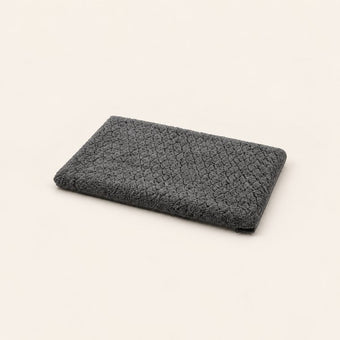
Thin pads (2–4 cm). Leave the most headroom, dry fastest, cheapest to replace. Right for puppies, for travel, and for any crate that is already a tight fit.
Thick pads (6–10 cm). More comfortable for an adult dog that spends real time in the crate, but they raise the dog closer to the roof and they take much longer to dry.
The deciding question is how much of the crate's internal height you can give up. A dog should be able to stand up and turn round. If the crate was bought to fit the dog with little margin, a thick pad takes that margin away.
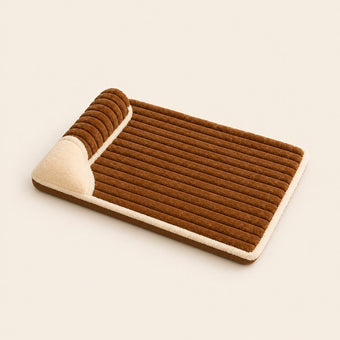
For a crate that is already tight, flat mats and pads are the safer choice.
Waterproof crate pads
Crates are where accidents happen — with puppies during house-training, with any dog left for longer than usual, and with dogs that are unwell.
A crate pad without a waterproof layer soaks through to the fill, and then the whole pad has to be washed and dried rather than just the cover. In a crate that is in daily use, that is the difference between a bed that is available tonight and one that is not.
Check the material rather than the word. Nylon, Oxford weave and coated polyester hold liquid out. Cotton, canvas and faux fur do not. A pad described as waterproof with a cotton material line is two contradictory statements, and the material line is the accurate one.
Washing is the deciding factor
Crate bedding gets washed more than any other bed, so start from the washable options.
Three things to look for:
A cover that comes off. On a thin pad this matters less, because the whole thing can go in the machine. On anything with foam, it matters completely.
A drying time you can live with. Thick foam takes a long time to dry through. In a crate used every night, a pad that takes two days to dry is a pad you will end up not washing.
A second pad. Cheaper than a second bed, and it means the crate is never empty on wash day.
Foam and water do not mix well, and washing a crate pad goes through what survives a machine.
Are crate beds chew proof?
Crate bedding gets chewed more than bedding elsewhere, usually by puppies and by dogs that are uncomfortable being confined.
We do not sell a bed we would describe as chew proof, and we would rather say that plainly than put the word on a product that would not survive a determined dog. A tightly woven synthetic resists wear better than plush or faux fur, and that is a genuine difference — but resisting wear is not the same as being chew proof, and a dog that sets out to destroy bedding will get through a woven cover too.
If your dog is currently destroying bedding, the practical answer is a thin, cheap, washable pad you can replace, rather than an expensive bed that will last three weeks. Chewing in a crate is also worth raising with a trainer or a vet, because it is often about the confinement rather than the bedding.
Using a crate pad for car travel
For a crate that goes in a car, weight and packability move up the list. A thin pad that rolls flat beats a thick one, and a wipe-clean surface beats a machine-washable one because you are usually cleaning it somewhere without a washing machine.
A non-slip base matters more in a moving vehicle than it does at home.
Crate bed checklist
- Pan measured inside edge to inside edge, not the crate frame.
- Pad thickness leaves the dog room to stand and turn.
- Waterproof layer confirmed by the material, not the description.
- Cover removable, or the pad thin enough to machine wash whole.
- Drying time compatible with nightly use.
- A second pad on hand.