Best Dog Beds for Large Dogs

The best dog bed for a large dog keeps its shape under the dog's weight, gives the whole body room to stretch out, stays put on the floor and has a cover you can wash at home. Measure the dog first, then read each size chart against the dog.
A large dog does not just need a bigger version of a small dog's bed. Weight changes what happens to the materials, and most beds that fail for big dogs fail in the same four ways. This page goes through them in the order they matter.
The general list — what to check on any bed — still applies here. This page is what gets added on top.
Everything on this page applies to the beds sized for large dogs we stock.
How to size a large dog bed
Bed sizes labelled "large" are not standardised. One brand's large is another brand's medium. The only number that means anything is the internal sleeping area in centimetres, compared against your dog stretched out.
Measure the dog lying on its side, from the nose to the base of the tail, and add roughly 15 to 20 cm. That is the minimum internal length. If your dog sleeps flat with its legs extended, measure to the end of the extended legs instead.
If you have not done it yet, how to measure a dog for a bed takes about two minutes.
A bed that is 10 cm short is not slightly wrong. The dog will hang its head or hips over the edge, which puts the joint you were trying to support on the floor.
Which bed type suits which sleeping style?
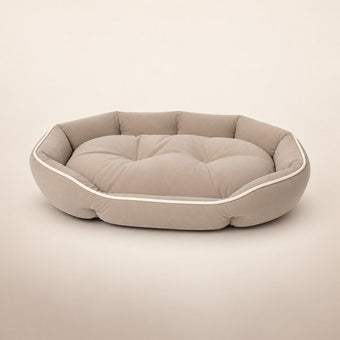
Choose the shape of the bed to suit how your dog sleeps. Curlers feel secure with bolstered edges. Sprawlers need a flat, mattress-style bed with room to stretch out. Larger dogs, such as Great Danes or German Shepherds, need high-density foam so the bed does not sag over time (guide from Simon Veterinary Surgical).

| Bed type | Suits | What to know |
|---|---|---|
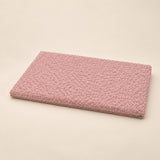
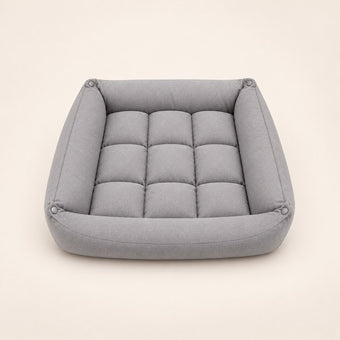
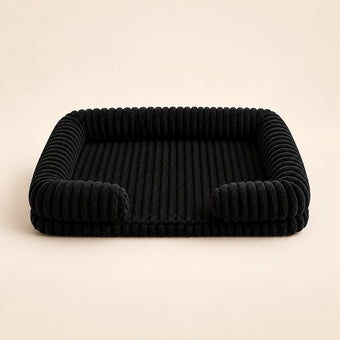
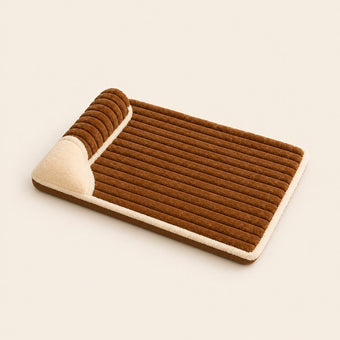
| Flat pad with no walls | Dogs that sleep stretched right out | Our Corduroy Dog Bed has no walls, so all of it is bed. The largest size is 45 x 31 in (115 x 80 cm). The cover comes off. |
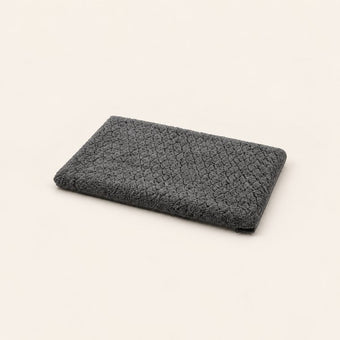
| Low foam mat | Dogs that sprawl | Our Washable Memory Foam Dog Bed has one short end sewn up into a pillow and three open, low sides. The largest size is 39 x 28 in (100 x 70 cm). The cover unzips. |
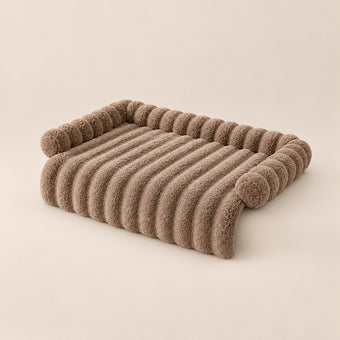
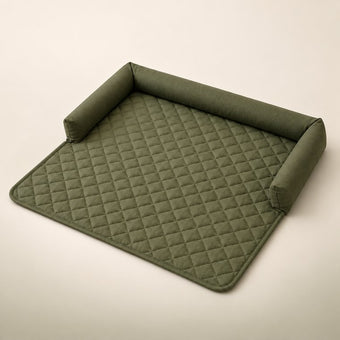
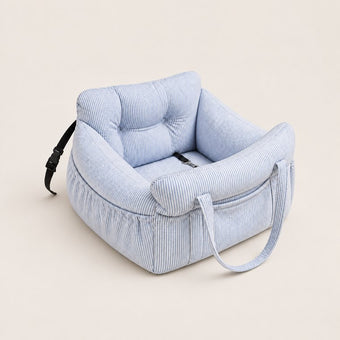
| Walled sofa bed with a low front corner | Older dogs that need a way in | Our Waterproof Corduroy Sofa Dog Bed is walled at the back and sides, with one front corner dropped for stepping in. It is rated by dog weight, up to 99 lb (45 kg). The walls take up room inside, so between two sizes take the bigger one. |
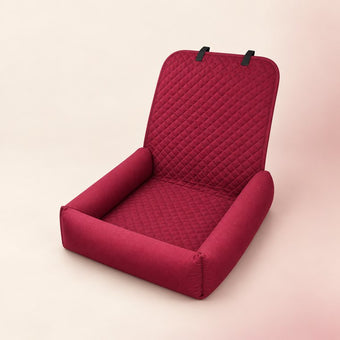
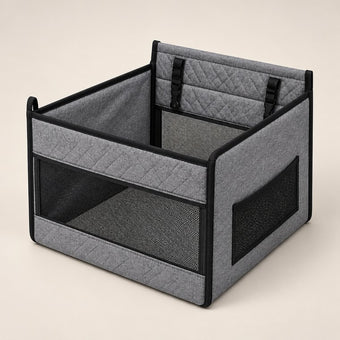
| Folding foam bed | Dogs that move between a crate, a car and a room | Our Foam Dog Bed with Washable Cover has 1.57 in of foam and is sized by weight, up to 99 lb. On tile it sits close to the floor, so pick accordingly. |
Check the care label of the size you choose. See also our guide to best dog beds.
What if your large dog has stiff joints?
For joint support, prioritize memory foam or orthopedic foam and look for a non-slip base that keeps the bed stable on hardwood or tile. VCA Animal Hospitals suggests an orthopedic or memory foam bed to reduce pressure on sore joints and improve sleep quality in a dog with osteoarthritis.
Ask your veterinarian before changing your dog's care. For older dogs, read our guide to best dog beds for senior dogs.
See also our large dog beds.

Failure one: the fill compresses and stays compressed
This is the difference between a bed that lasts and one that flattens.
Loose polyester fibre compresses under weight and recovers less each time. Under a 10 kg dog that takes a long while to become noticeable. Under a 35 kg dog it can take weeks. Once the fill has bottomed out, the dog is lying on the floor through a fabric layer.
Solid foam behaves differently — it compresses and returns, and the higher the density the longer it keeps doing that.
You can tell them apart before buying by weight. A solid foam slab is heavy: a bed around 85 × 53 × 27 cm made of real foam weighs several kilograms, while the same footprint filled with fibre can weigh under 2 kg. If a large bed ships at 1 kg, there is no foam slab inside it, whatever the listing says.
For a dog over about 25 kg, foam beds that hold their shape are the only category worth checking.
Failure two: the edges collapse
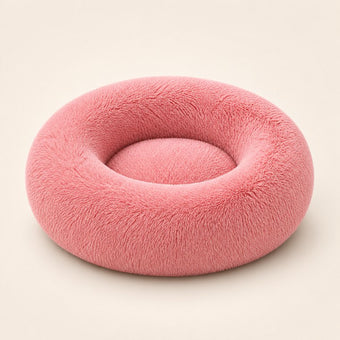
Big dogs lean on the sides. On a bed with a rim, the rim is usually stuffed with the same loose fibre as the base, and it gives way first — within a few months the raised edge is a soft fold rather than a support.
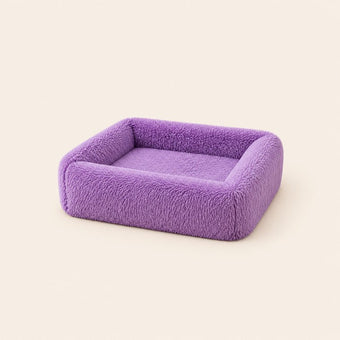
Two things to look for. First, whether the rim is stuffed or has a foam bolster inside it. A foam bolster keeps its shape; stuffing does not. Second, whether the rim is stitched into the base or sewn on as a separate tube. A separate tube can roll outward under weight and take the dog's shoulder with it.
Some large dogs sleep stretched flat and get nothing from beds with sides. If that is your dog, a flat rectangular bed uses the same footprint with more usable area.
Failure three: the bed slides across the floor
A large dog throws its weight into a bed when it lies down. On tile, laminate or polished wood, a bed with a plain fabric base moves — sometimes far enough that the dog ends up half off it.
Look for a base with a rubberised or silicone-dotted layer. It is a small feature and it is the one most often missing. On a bed you already own, a non-slip rug underneath solves the same problem.
Failure four: the cover does not fit your washing machine
This is the practical one, and it is almost never mentioned on the product page.
A cover for a bed 120 cm long, with a foam-filled rim, is a large volume of fabric. Machine-safe does not mean machine-sized. Before buying, check the drum capacity of your machine and think about whether that cover, wet, will turn in it. A cover that only fits a laundrette is a cover that gets washed less often than it should.
Look for covers that come off for washing before you look at anything else — and if the bed is large, look for one with a two-piece cover, where the base and the rim wash separately. Two smaller loads beat one that does not fit.
Two things that matter more in summer
Large dogs shed heat more slowly than small ones, which is why how cooling beds work for bigger dogs is worth reading before summer.
The short version: a thick foam bed insulates. That is useful in winter and works against you in July. If the same bed is used year round, a cooling mat placed on top in summer is simpler than owning two beds.
A short checklist
Before you buy a bed for a large dog:
- Internal sleeping length is at least nose-to-tail plus 15–20 cm.
- The listed weight is consistent with solid foam, not loose fibre.
- The rim, if there is one, has a foam bolster rather than stuffing.
- The base has a non-slip layer.
- The cover comes off, and it fits your machine.
Five checks. Four of them can be answered from the product page before you order; the fifth needs a tape measure and thirty seconds at your washing machine.
Quick answers
What sizes do dog beds come in?
Sizes vary by bed, so compare the size chart with your dog's measurements rather than the size label. Our Corduroy Dog Bed comes in three sizes, from 31 x 23 in (78 x 58 cm) to 45 x 31 in (115 x 80 cm). Our Foam Dog Bed with Washable Cover is sized by dog weight: 23 x 16 in up to 15 lb, 29 x 18 in up to 33 lb, 35 x 23 in up to 55 lb and 41 x 26 in up to 99 lb. Our Waterproof Corduroy Sofa Dog Bed has five sizes, rated from 4 lb (2 kg) up to 99 lb (45 kg).
Do dogs like smaller or bigger beds?
A sprawler needs a flat bed with room to stretch out. A curler is more at home with bolstered edges. On a bed with walls the inside is smaller than the outside, so take the bigger size when you are between two.
Which dog bed do vets suggest for joint problems?
VCA Animal Hospitals advises considering an orthopedic or memory foam bed for a dog with osteoarthritis. The American Kennel Club calls a supportive bed imperative for dogs with arthritis, hip dysplasia and other joint issues.