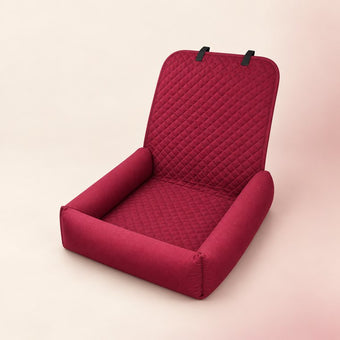
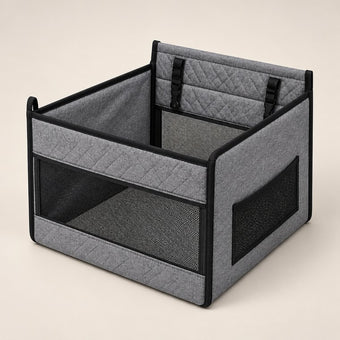
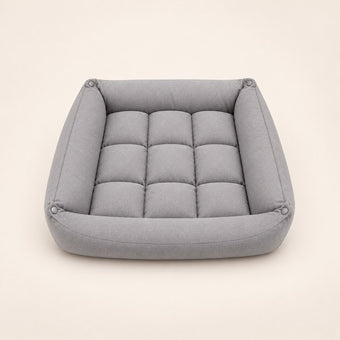
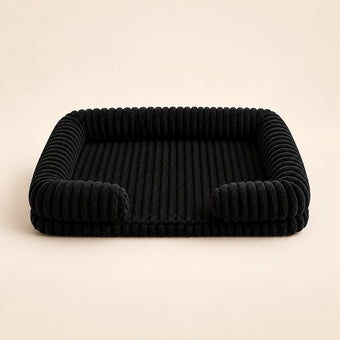
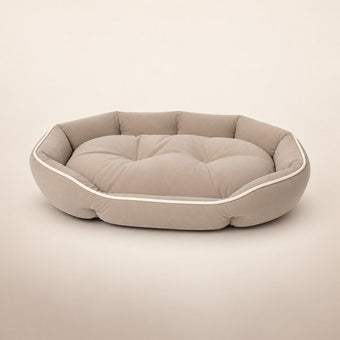
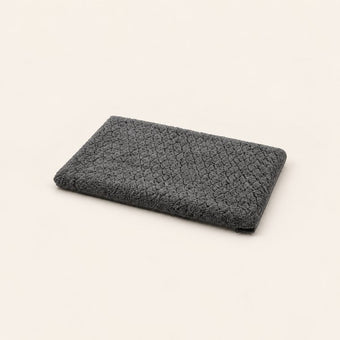
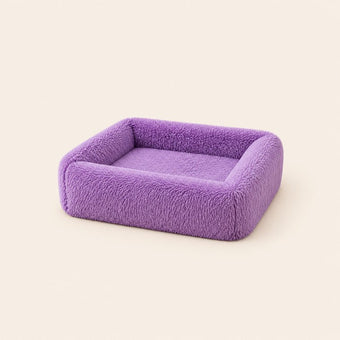
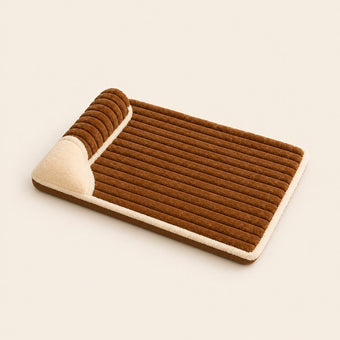
Best Cooling Dog Beds for Large Dogs

A large dog carries more body mass per unit of skin than a small one, which means it sheds heat more slowly. That is why the bed question changes in summer for big dogs specifically, and why a bed that is fine in October can become the warmest place in the room in July.
There are three mechanisms that move heat away from a dog. A listing should be able to tell you which one it uses. If it cannot, that is usually because it uses none of them.
The cooling beds and mats we carry use one of these three approaches.
Mechanism one: a gel layer
A gel pad or a gel-infused foam absorbs heat on contact. The dog lies down, heat moves into the gel, and the surface feels cool.
What to know: it works by absorption, so it has a limit. Once the gel has taken up as much heat as it can hold, it stops feeling cool and needs time without the dog on it to release that heat back into the room. For a dog that lies in one place for hours, that limit is reached.
Best for: naps and short rests, indoors, in a room that is not itself very hot. Also the only one of the three that needs no setup and no water.
Size note: gel is heavy and expensive, so large gel pads cost significantly more than small ones. Some large "gel" beds have a gel panel covering only part of the surface. Look at where the panel sits — if it does not cover the dog's whole torso, most of the dog is on ordinary foam.
Mechanism two: a water-fill chamber
You fill a sealed chamber with cold tap water. The water sits at or below room temperature and takes heat out of the dog by conduction. Because water holds a lot of heat, this keeps working longer than a gel pad.
What to know: it needs filling, and it needs emptying and drying before storage. It is also heavy once filled, which is fine for a bed that stays in one place and awkward for one that moves.
Best for: large dogs, hot days, a fixed location. This is the mechanism with the most capacity and it is the one most suited to a big dog.
Watch for: dogs that dig or chew. A punctured water mat empties onto the floor. If your dog scratches at bedding before lying down, this is not the right one.
Mechanism three: a breathable weave
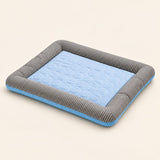
Ice silk, mesh, and stretched frame fabric all work the same way: instead of absorbing heat, they let air move. No heat is stored, so there is nothing to exhaust and no limit to reach.
What to know: it depends on there being air movement. In a still, hot room the effect is small. On a patio with a breeze, or under a fan, it is the most consistent of the three.
Best for: outdoors, and for dogs that reject anything that feels wet or rubbery underfoot.
Outdoors, a raised frame with airflow underneath often beats a mat. That is a different mechanism, and what a raised bed does explains where it works.
Dog beds that are not really cooling
A thinner polyester bed sold as the summer version. Less padding is not heat transfer. If the only difference between the summer model and the winter model is the thickness, it is a thinner bed. It will feel cooler than a thick one because there is less insulation between the dog and the floor — but a bare tile floor would do the same thing for free.
"Breathable" printed on a solid foam bed. Foam insulates. A breathable cover over a solid foam core still has foam underneath.
Colour. A light-coloured bed does not run cooler indoors.
This distinction matters when comparing prices. A real cooling mechanism costs money — gel is heavy, water chambers need sealed construction, quality mesh is not cheap. A summer bed priced like a thin mat is a thin mat.
Cooling dog bed size for large dogs
A cooling surface only cools the part of the dog touching it.
This is where cooling products for large dogs go wrong most often: a mat sized for the average dog leaves half of a big dog on the floor, and the dog will move off it entirely rather than lie half on. Measure the dog stretched out on its side, and buy a surface that covers the whole torso.
Cooling surface has to match the dog, so start from large-dog sizes.
Everything else about picking a bed for a big dog still applies in summer.
Cooling bed placement
All three mechanisms work better away from direct sun and away from a warm wall. A cooling mat on a sunlit patio is absorbing heat from the sun as well as from the dog.
Indoors, the coolest floor in the house is usually tile in a north-facing room. Putting the mat there and letting the dog choose is more effective than putting it where you would like the dog to sleep.
One bed plus a cooling mat for summer
Most homes do not have space for two full beds. The arrangement that works is one good bed used year round, with a cooling mat placed on top of it in summer and removed in autumn.
That also solves the storage question, since a mat rolls up and a bed does not.
Cooling dog bed checklist
- The listing names a mechanism: gel, water fill, or breathable weave.
- The cooling surface covers the dog's whole torso, measured lying down.
- If gel: the panel covers the surface, not a section of it.
- If water fill: the dog does not dig or chew at bedding.
- If weave: there is air movement where the bed sits.
- The price is consistent with a real mechanism rather than less padding.