Best Dog Beds for Senior Dogs

A senior dog's bed needs three things the old one may not have had: a low entry it can step onto without a jump, foam that stays flat under a two-hour nap, and a cover that comes off for a weekly wash. Cooling or warmth is a fourth, depending on the dog.
An older dog uses a bed differently. It gets in and out more slowly, spends longer lying in one position, and is more likely to have an accident on it. Those three changes point at specific features, and none of them is the word "senior" printed on a listing.
A bed is not a treatment. If your dog has become stiff, slow to rise, or reluctant to lie down, that is a conversation with a vet, not a shopping decision. What a bed can do is remove some of the physical work from getting up and lying down, and stay comfortable through a longer nap.
Entry height is the feature nobody lists
A dog with stiff hips has to lift each leg over the edge of the bed. On a bed with a 20 cm padded rim, that is a step. On a flat mat it is nothing.

This is the single most useful thing to check, and almost no product page states it. You can usually work it out from the photos: look at where the rim sits relative to the base, or look for a bed with one lowered side — some bolster beds have a deliberate low front edge for exactly this reason.
If your dog already hesitates before stepping onto its current bed, that hesitation is the answer. Go lower.
The trade-off is real: a rim gives a dog something to rest its head on, and older dogs often like that. A bed with a raised back and a low front gives both.
Fits a large or heavy senior that pauses at a raised rim; it is less important for a dog that still steps onto its current bed without hesitation.
Foam that holds under a longer nap
Older dogs lie still for longer. That makes the difference between fill types more noticeable, because loose fibre compresses over the course of a single long sleep and leaves the dog resting on the floor through fabric.

Solid foam keeps its thickness under continuous weight, and thickness is what keeps pressure off the points that touch — hips, elbows, shoulder.
You can check whether the foam is real before you buy, by weight. A bed roughly 85 × 53 × 27 cm made from a solid foam slab weighs several kilograms; the same size filled with loose fibre can weigh under 2 kg. A listing that says orthopedic and ships at 1 kg is describing a thin foam sheet on top of fibre, which flattens.
This is the whole reason orthopedic beds exist as a separate category.
Thickness matters as much as material. A 5 cm foam sheet under a 30 kg dog compresses close to the floor. For a heavier dog, look for 8 cm or more.
Fits a dog that stays in one position through a long nap; skip any bed whose page does not state what is inside it.
What to check in the bed
Check three things: the foam, the way in and the floor around the bed.
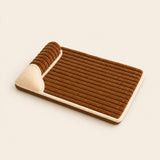
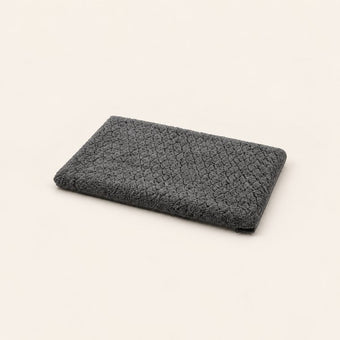
- Supportive foam. VCA Animal Hospitals suggests an orthopedic or memory foam bed to reduce pressure on sore joints and improve sleep quality. The Canine Arthritis Resources and Education site (CARE) lists memory foam mattresses as supportive bedding. Our Washable Memory Foam Dog Bed is a low foam mat for dogs that sprawl, with a cover that unzips.
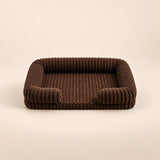
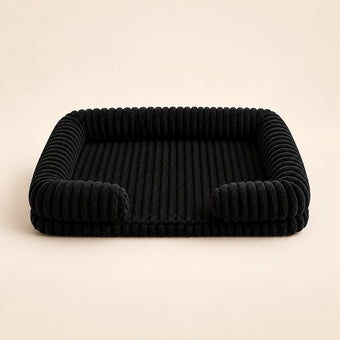
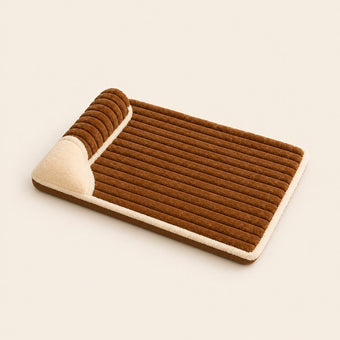
- A low way in. VCA says the ideal bed may be a recessed orthopedic bed that does not require the dog to climb onto it. Our Waterproof Corduroy Sofa Dog Bed has a lowered front corner, so an older dog can step in without climbing.
- A floor that grips. CARE asks for bedding in a warm, non-drafty spot with non-slick flooring under and around the bed. Where the floor is tile or hardwood, CARE suggests covering slick surfaces with rugs, yoga mats or gym floor tiles, and says a rug needs a non-skid pad beneath it.
VCA says accidents can happen more often in dogs with mobility problems, and that the bed or bed cover should be machine washable.
For a bigger dog, see our best dog beds for large dogs.
How to measure a senior dog for a bed
Older dogs often stop curling and start sleeping stretched out, sometimes on their side with legs extended. A bed that fit for years can stop fitting without the dog changing weight.
Measure while the dog is lying in its usual position, from nose to the base of the tail, then add 15 to 20 cm. If the legs extend past that, measure to the paws.
Older dogs stretch out more than they curl, so measuring the dog rather than guessing matters more here.
Measure again even if the previous bed once fit; do not reuse the old bed size after the dog's sleeping position has changed.
Accidents change what the bed needs to be
Incontinence is common in older dogs and it changes the requirements more than anything else on this page.
Once liquid reaches foam, it stays there. Foam holds moisture, dries slowly, and starts to smell. The fix is a barrier between the cover and the fill — a waterproof liner, not just a waterproof outer shell.
The difference matters. A waterproof outer keeps liquid out of the cover, which means it sits on the surface. A liner lets the cover absorb it and stops it before the foam, so you wash the cover and the bed is fine.
If accidents have started, a bed with a waterproof layer saves the foam underneath.
Check the material rather than the word. Nylon, Oxford weave, coated polyester and leather hold water out. Cotton, canvas and faux fur do not, regardless of what the description says.
Fits a dog that has started having accidents; it adds little when the bed and its fill stay dry.
Washing goes from monthly to weekly
This is the change most people are not ready for. A bed that needed washing once a month may need washing every few days.
Two things follow from that. First, the cover has to come off easily — a zip that runs most of the way round, not a fitted sleeve you have to peel. Second, you need a second cover, because a bed cannot be out of use for a day when the dog needs it.
Buying spare covers at the same time means the bed is never out of use on wash day.
Washing gets more frequent with an older dog, so what washable means is worth reading first.
Fits a cover that now needs frequent washing; a spare is less important when the bed is rarely out of use for cleaning.
Temperature: older dogs feel it both ways
Thin dogs and dogs that have lost muscle feel cold floors more. Heavy-coated dogs still overheat in summer. A thick foam bed insulates, which helps in winter and works against you in July.
The simplest arrangement is one good foam bed used year round, with a breathable mat placed on top in hot weather. Two beds is more expensive and takes more floor space than most homes have.
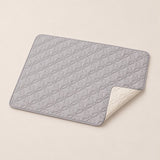
Cooling fits a dog that leaves the bed for tile, while extra warmth fits one that seeks blankets or avoids a cold floor; use neither signal if the dog settles on its current surface.
Senior dog bed checklist
- The front edge is low enough for the dog to step onto without pausing.
- The product page states what the fill is, and the surface does not bottom out under the dog's weight. Check the construction on the product page before the word "orthopedic".
- The internal sleeping length fits a fresh nose-to-tail measurement, with room for the dog's usual position.
- A waterproof barrier keeps liquid from reaching the fill when accidents have started.
- The cover comes off without peeling it over the whole bed, and the care instructions state that it can be washed.
- The surface matches the room and the dog: breathable when the dog leaves for a cool floor, insulated when it seeks warmth.
Six things. None of them is the word "senior," and all six can be checked before the bed arrives.
Quick answers
What is the best bed for a senior dog with arthritis?
A bed does not treat arthritis. What it can do is make lying down and getting up easier: a low entry the dog can step onto, and a fill that stays flat under its weight. Of the beds we carry, the Washable Memory Foam Dog Bed is the one whose listing names memory foam; the rest are in dog beds.
Should a senior dog have an orthopedic bed?
It helps when the listing says what the fill is, because "orthopedic" on its own is a label, not a construction. If the dog stiffens after a long nap, look for foam that holds its shape and a low front edge, and compare options in dog beds.
Where to go next
 CollectionDog BedsEvery shape in one place: flat beds, bolsters and sofa beds
 CollectionLarge Dog BedsRoom to stretch out for big and giant breeds
 CollectionWaterproof Dog BedsBeds and layers that keep liquid on the surface
 CollectionWashable & Waterproof Dog BedsLiquid stays on top and the cover goes in the machine
 CollectionCooling Dog BedsIce-silk mats for dogs that leave the bed for the tile
 JournalDog Bed Sizes: How to Measure Your DogHow to measure your dog before you choose a size