
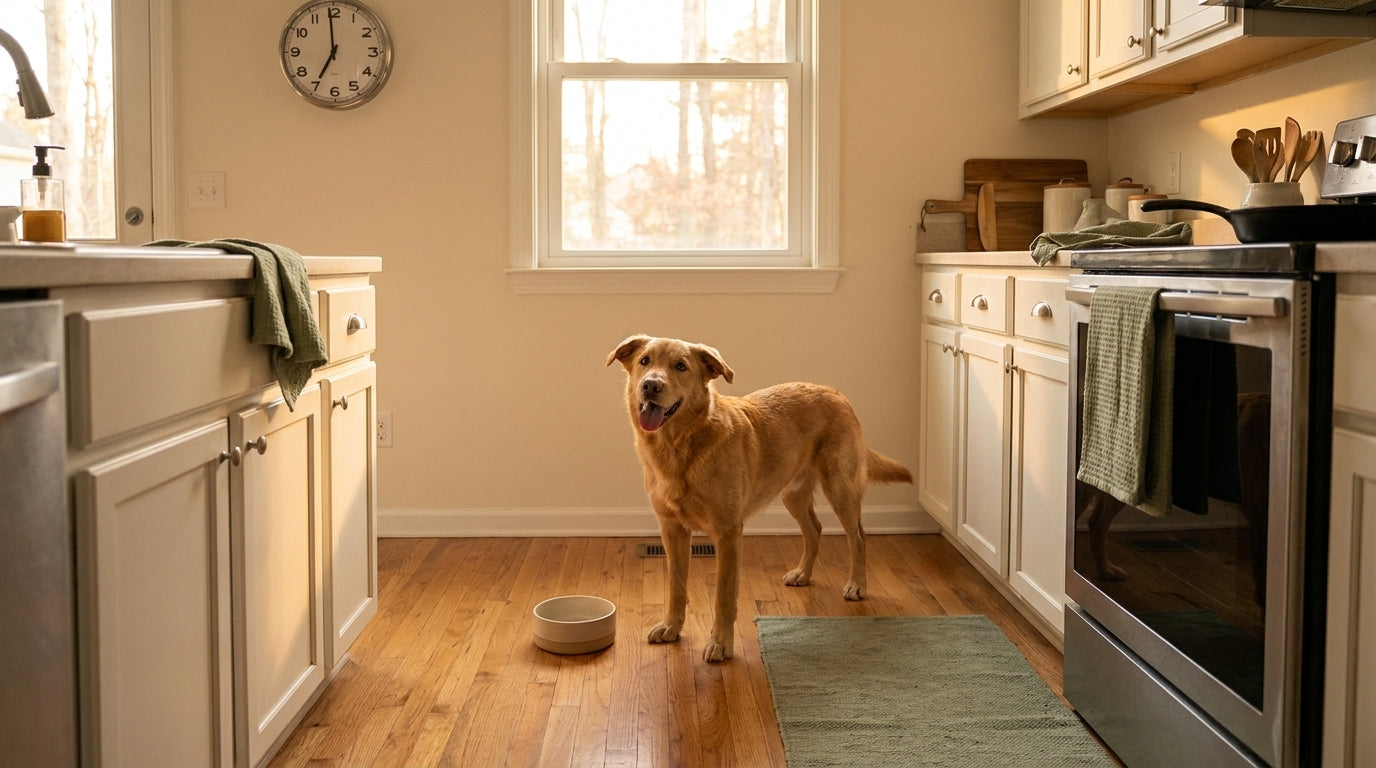
Your dog's bowl hits the floor. Thirty breaths later, it is empty. No chewing, no pausing, no satisfaction. Just a ritual that ends before it begins.
The scene everyone ignores

The 60-second meal looks like enthusiasm. It is mostly mechanics. Three things happen when a dog inhales food at speed, and each one carries a downstream cost the bowl itself does not show.

"Air, not just food, fills the stomach."
A dog vacuuming kibble at full speed swallows large volumes of air alongside the food. In deep-chested breeds (Great Danes, German Shepherds, Standard Poodles), that air is the most modifiable risk factor for GDV, which carries roughly 30 percent mortality even with emergency surgery.
Glickman et al., Journal of the American Veterinary Medical Association, 2000

"The brain has not received the memo yet."
Satiety hormones (leptin, ghrelin, cholecystokinin, peptide YY) take roughly 15 to 20 minutes to reach the brain. A dog who finishes kibble in 60 seconds is done 19 minutes before the brain registers fullness. Stretch the meal to 10 minutes and the signals arrive in time.
Peer-reviewed satiety-hormone literature in mammalian feeding research

"The eating reflex never engages the parasympathetic system."
Slow, deliberate eating triggers the rest-and-digest response. Sixty-second meals skip that activation entirely. The dog finishes the meal in the same nervous-system state she started, often manifesting as post-meal pacing, food guarding, or counter-surfing for "more."
Overall, Clinical Behavioral Medicine for Dogs and Cats, 2013
The 21-day slow-meal protocol
The 60-second meal does not change overnight. Three weeks of structured pacing shifts the meal into the 10 to 15-minute window where the body and brain can actually use it.
Surface acclimation
Depth transition
Full protocol
The two-week test
If 21 days feels too long to commit, run a 14-day test instead.
- Day 0: baseline. Time the meal. Photograph the dog's profile. Note post-meal behavior in the first 10 minutes.
- Day 14: re-measure. Same time of day, same kibble portion, in the slow feeder. Re-photograph profile. Note post-meal behavior.
- The honest signal. Meal time should have extended to 8 to 10 minutes. Post-meal pacing should be visibly softer. Air-swallow signs (loud burping, retching) should have dropped.
- If the test fails. Pattern may not be hardwired speed. Check for anxiety signals during meals or competition with another household animal. The cause shifts the intervention.
The 60-second meal is the easiest feeding problem to fix and one of the most consequential to leave alone. A slow feeder, a calm meal environment, and three weeks of consistency change the math.
Severity matrix: what stage, what to do
| Stage | What you see | What to do |
|---|---|---|
| Early (under 30 min) | Restless pacing, drooling, looking at the belly or flank, unproductive retching beginning | Call the emergency vet now. Drive. Do not wait to see if it passes. |
| Mid (30 to 60 min) | Distended abdomen tight as a drum, repeated retching, visible distress, refusing water | You should already be at the vet or en route. Time is the only variable. |
| Late (60+ min) | Pale or muddy gums, weak rapid pulse, collapse, inability to stand | Surgical emergency. Every minute now changes the survival odds. |
Frequently asked questions
What are the first signs of bloat in a dog?
The earliest signs are behavioral: restless pacing, repeated position changes, looking at the flank, and a praying posture with the chest down and rear up. The most specific early sign is unproductive retching, where the dog makes the motion of vomiting but nothing comes up. A distended abdomen and excessive drooling follow within the first 20 to 40 minutes.
How do you prevent bloat in dogs?
The most effective levers are slowing ingestion speed (a slow feeder bowl reduces it 5 to 10 times), feeding two or three smaller meals per day rather than one large meal, keeping bowls on the floor (raised feeders increased risk in large breeds per Glickman 2000), and avoiding vigorous exercise within an hour of eating. For the highest-risk breeds, ask your veterinarian about prophylactic gastropexy.
What breeds are most at risk for bloat?
Deep-chested breeds carry the highest risk. Great Danes top the list at roughly 37 to 42% lifetime probability without surgical prevention. Saint Bernards, Weimaraners, Irish and Gordon Setters, Standard Poodles, German Shepherds, and Doberman Pinschers all show elevated rates. Chest shape (deep and narrow) is the underlying driver, not body size alone.
Can a slow feeder bowl prevent bloat?
A slow feeder bowl does not eliminate bloat risk, but it addresses the single most controllable contributing factor, ingestion speed. Peer-reviewed testing shows ingestion-rate reductions of 5 to 10 times depending on bowl design. Combined with smaller meals, calm mealtimes, and exercise timing, it is one of the most evidence-supported daily interventions an owner can use.
What should I do if I think my dog has bloat?
Drive to the nearest 24-hour emergency veterinary hospital immediately. Call ahead so the surgical team is ready. Do not feed water, do not give anti-gas or pain medications, and do not attempt home decompression. The only intervention that resolves a gastric volvulus is surgical, and the survival window is roughly two hours from onset of clinical signs.
Is bloat the same as a regular upset stomach?
No. Regular gastric upset usually involves productive vomiting and resolves within hours. Bloat involves unproductive retching, rapid abdominal distension, and progressive distress. A dog who throws up once and then settles is most likely not bloating. A dog who retches repeatedly without producing anything, paces, and has a tightening belly almost certainly is.