
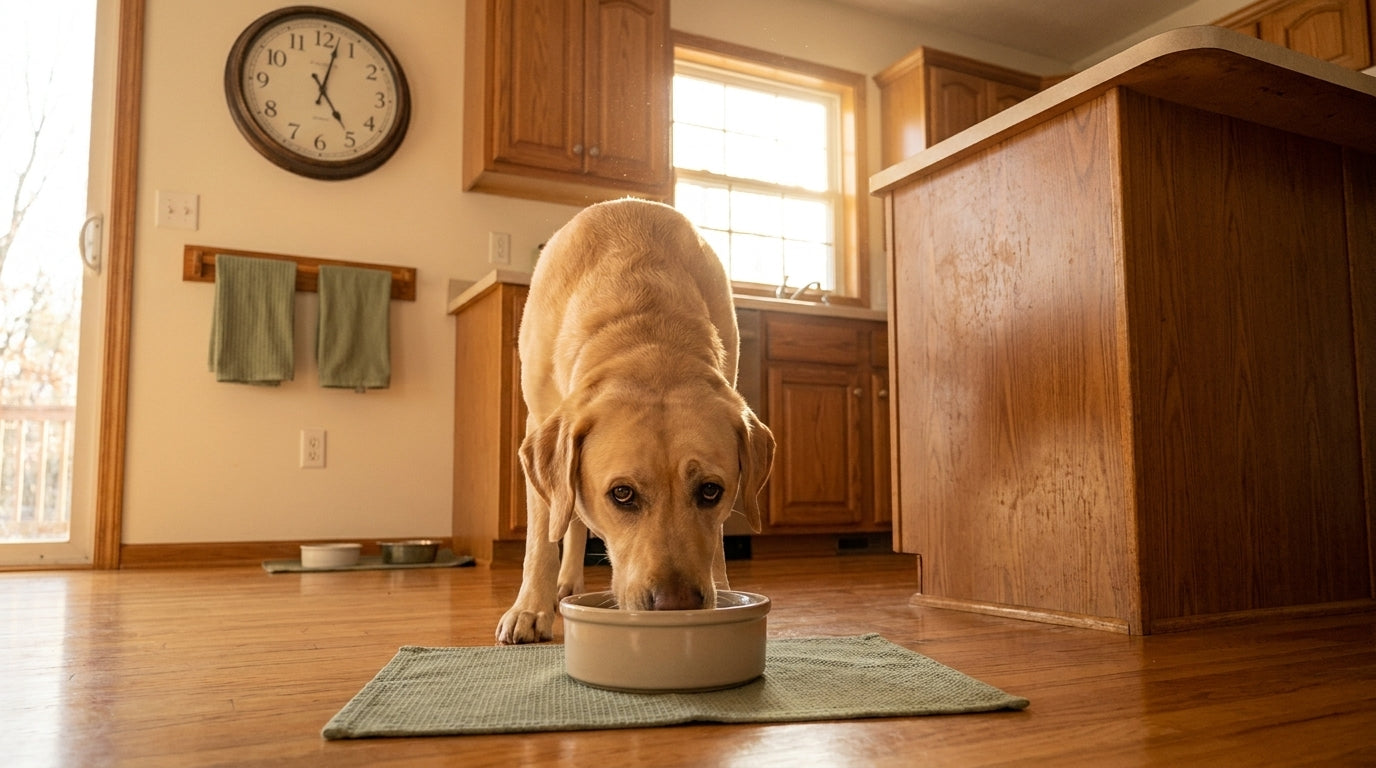
You put the bowl down at 7:01 PM. By 7:02 PM, the bowl is empty. She is now staring at you with the energy of someone who has not eaten in a week. You think: this cannot be right. You fed her twice this much as a puppy and she did not do this then. You start wondering if she is sick, or stressed, or somehow getting away with something.
The three causes of fast eating (and why each matters)

Fast eating looks like one behavior but it traces to three different causes. Each cause has the same surface symptom and a different underlying driver. Picking the right intervention depends on which one you are looking at.

"Dog eats fast from puppyhood, regardless of environment or competition. Consistent across years. No other anxiety or competition signals."
Hardwired evolutionary pattern. Common in working breeds and ancestral-line mixed breeds. Not a behavioral problem; a species-typical behavior expressing itself. Slow feeder is the appropriate and sufficient intervention.
Coppinger & Coppinger, Dogs: A Startling New Understanding, 2001

"Fast eating in an adopted or formerly multi-dog-household dog. Behavior may have intensified after a specific event (rehoming, sibling separation, new household member). Dog watches surroundings during eating."
Survival behavior learned during food competition or scarcity. Persists after the competition is gone. Slow feeder addresses the speed; environmental changes (separate feeding space, consistent routine) address the underlying association.
Bradshaw, Dog Sense, 2011

"Fast eating accompanied by other anxiety signals: pacing during food prep, frequent looking around mid-meal, refusal to eat with people present, eating only when alone. May coincide with other anxiety patterns elsewhere."
Eating itself is a stressor for this dog. The fast pace reflects a desire to finish the vulnerable moment quickly. Slow feeder helps mechanically; deeper anxiety work (parasympathetic activation, quiet feeding environment) is also needed.
Overall, Clinical Behavioral Medicine for Dogs and Cats, 2013
The 21-day slowdown protocol
Three weeks of structured intervention shifts the meal from a 60-second swallow to a 10 to 15-minute eating event with steady pacing.
Surface acclimation
Depth transition
Full protocol
What does not work (and why some interventions make it worse)
Three popular fixes either fail outright or accelerate the wrong pattern.
- A tennis ball in the bowl. Small choking hazard. Limited slowdown effect. Replaced by every proper slow-feeder design.
- Hand-feeding entire meals. Slows the dog but installs a dependency. The first meal you cannot hand-feed reverts to the old pattern. Use only as a short-term diagnostic, not a long-term fix.
- Free-feeding (food always available). Fails for Pattern 1 (the dog still eats fast in spurts). Worsens Pattern 2 by removing the routine that anchors safety. Removes the calibration signal that lets you track BCS.
The fix for fast eating is mechanical (slow feeder) plus pattern-specific (environment for Pattern 2, anxiety work for Pattern 3). Three weeks of structured protocol replaces years of the 60-second meal.
Match the pattern to the intervention
| Pattern | Slow feeder alone is enough? | What else to add |
|---|---|---|
| Ancestral instinct | Yes | Nothing additional needed |
| Learned competition | Mostly | Separate feeding space, consistent routine, no time pressure |
| Anxiety-driven | No | Slow feeder + quiet environment + parasympathetic activation (lick mat between meals) |
| Resource-guarding adjacent | Caution | Slow feeder helps, but behaviorist consultation may be needed for the underlying guarding |
Frequently asked questions
Why does my dog inhale his food?
One of three reasons: ancestral instinct (hardwired evolutionary pattern), learned competition (history of multi-dog or scarcity environment), or anxiety-driven feeding (eating itself is stressful). Slow feeders address all three mechanically; the behavioral context determines what else needs to happen.
Is it bad if my dog eats fast?
Yes, for medical reasons. Fast eating contributes to air-swallowing, gastric distention, post-meal vomiting, satiety signaling failure, and elevated bloat risk in at-risk breeds. The medical case for slowing is established. Slow feeders are the most cost-effective intervention.
Why does my dog eat like she is starving?
Most healthy adult dogs are not actually hungry in the medical sense; they are food-motivated and executing patterns that worked historically. Genuine hunger from undernutrition produces weight loss and energy changes, not just enthusiastic eating. Behavioral patterns explain most cases of "eating like starving."
How do you slow down a dog that eats too fast?
Slow feeder bowls are the most effective single intervention. Maze and puzzle designs extend the meal from 60 seconds to 15 to 25 minutes. Most dogs accept the new format within 1 to 3 meals. For learned competition or anxiety-driven patterns, layer environmental changes alongside the bowl.
Will a slow feeder bowl really help?
Yes, mechanically and immediately. The ridges and mazes force the dog to navigate around obstacles to access food, which physically slows the pace. Combined with the slower meal allowing satiety signaling to engage, the dog ends the meal more satisfied with the same amount of food.
Can I just put a ball in my dog's bowl?
A tennis ball provides marginal improvement over a regular bowl but works less well than a proper slow feeder. The ball moves out of the way as the dog eats. A structured maze bowl forces sustained navigation. The cost difference between the two interventions is small; the effectiveness difference is large.