
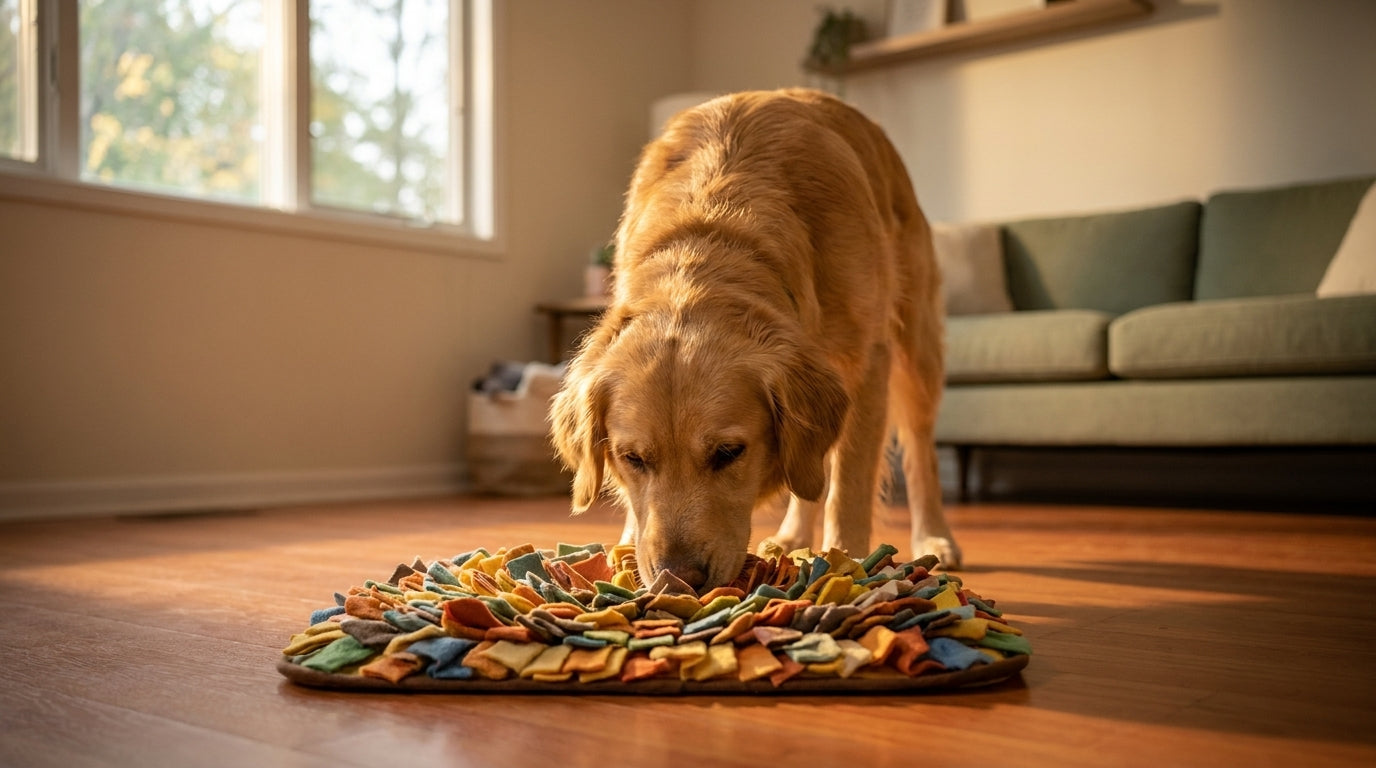
You have walked her for an hour. You have thrown the ball forty times. You have done that mock tug-of-war thing for ten minutes. She is now standing in front of you, holding her leash in her mouth. The walk was not enough. The ball was not enough. You are tired. She is not tired.
What a snuffle mat actually does (the cerebral glucose story)

The dog brain runs on glucose. Olfactory processing is approximately 40 times more energetically expensive than visual processing, every successful sniff burns measurable cerebral fuel at rates that exceed most physical activity below a sprint. A 15-minute structured foraging session depletes the same energy reserve as a 60-minute walk, without leaving the legs sore. This is the cerebral glucose mechanism the rest of this guide unpacks.

"15 minutes of structured foraging produces the same cerebral fuel depletion as 60 minutes of low-arousal walking. Mental fatigue without the physical wear-and-tear."
Olfactory processing is approximately 40 times more energetically expensive (per gram of brain tissue) than visual processing in dogs. Working scent burns measurable cerebral glucose at rates that exceed most physical activity below a sprint.
Horowitz, Inside of a Dog, 2009

"The repetitive nose-down posture and rhythmic foraging movement engage the parasympathetic nervous system. Heart rate drops, cortisol clears, and the dog enters a measurable calm state."
Same autonomic pathway as lick work (vagal nerve engagement). Clinical observation shows reduced anxiety markers within 5 to 10 minutes of sustained foraging.
Mariti et al., Veterinary Behavior, 2018

"Snuffle mats resist the 'figured it out' problem that kills most puzzle toys within days. The scent profile of hidden food changes every session, so the work stays novel."
Olfactory tasks habituate more slowly than visual or mechanical tasks in dogs. The same mat with rotation maintains engagement at week 4 and beyond.
Bradshaw, Dog Sense, 2011
How to use a snuffle mat (the 4-week buildup)
A snuffle mat without a protocol is a fabric square. The protocol is where the behavioral change lives.
Mat introduction & surface foraging
Surface to depth transition
Difficulty layering & meal replacement
Rotation & advanced setups
When a snuffle mat is the right tool (and when it is not)
A snuffle mat is not the answer to every behavioral question. Knowing the difference saves a month of using the wrong intervention.
The snuffle mat is the right tool for:
- Boredom-driven destructive behavior (chewing, digging, vocalizing for attention). The cognitive load takes the place of the destruction loop.
- Indoor energy management when walking is limited (bad weather, apartment living, owner schedule constraints).
- Pre-departure routines for dogs with mild separation anxiety. A loaded mat at the moment of departure changes the autonomic state the dog enters absence in.
- Senior dogs with early cognitive decline. Regular olfactory work slows the rate of canine cognitive dysfunction (CCD) progression in measurable amounts (Milgram et al., 2005).
- Hyperactive young dogs who appear "untireable." The mat targets the cognitive system that physical exercise leaves untouched.
The snuffle mat is not the right tool for:
- Severe separation anxiety. A panicking dog will not engage with the mat. Address the panic first (vet, behaviorist, medication), then the mat fits in after stabilization.
- Resource-guarding cases with food. The mat is a food-delivery system; using it with a resource-guarder requires desensitization first.
- Dogs who chew and swallow non-food objects compulsively (pica). The mat fabric is durable but not designed for ingestion. Supervise these dogs or choose a different tool.
- Very large or very strong dogs who shred fabric reflexively. The mat will not survive. A puzzle feeder or licking surface is a better fit.
Is a snuffle mat the right tool for your dog?
| Profile | Snuffle mat fit | What to pair it with |
|---|---|---|
| Bored, high-energy adult dog | Excellent | Daily 15-min sessions + structured walks |
| Anxious adult dog (mild to moderate) | Good for daily baseline lowering | Lick pad for acute moments, plus snuffle mat for routine |
| Senior dog with early cognitive signs | Strong long-term value | Daily short sessions, gradual difficulty layering |
| Severely reactive or panicking dog | Poor fit until baseline stabilizes | Address baseline first via vet, then introduce |
Frequently asked questions
Do snuffle mats actually work?
Yes, when used with a protocol. The cerebral glucose depletion is measurable; the autonomic calming effect is observable. The mat without a protocol is a fabric square. The mat with the 4-week buildup is a reliable behavioral tool.
How long should my dog use a snuffle mat?
Start at 5 to 7 minutes per session. Build to 15 to 20 minutes by week 3. Most dogs benefit from one to two sessions per day. Sessions longer than 25 minutes start producing diminishing returns and occasional frustration.
Are snuffle mats good for puppies?
Yes, for puppies past weaning age (around 8 weeks). Use surface foraging only at first, with smaller portions. Puppies pick up the activity quickly and benefit from the cognitive load. Supervise to prevent fabric chewing.
How do you clean a snuffle mat?
Shake out loose debris after every session. Machine wash weekly on a gentle cycle with pet-safe fragrance-free detergent. Air dry or tumble dry completely before next use. Inspect monthly for loose stitching. Never use wet food on fabric mats; bacterial growth in porous fibers is unavoidable with wet food.