
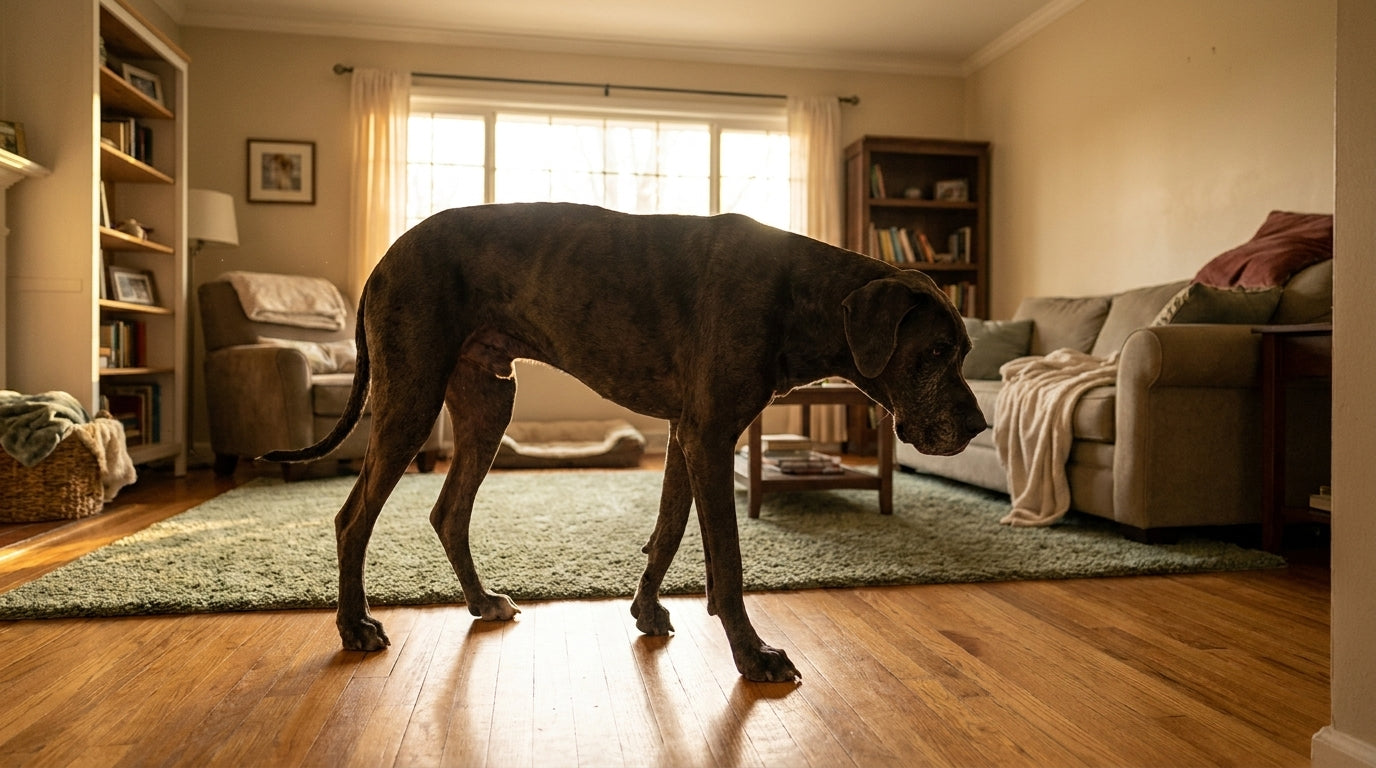
It is 8:30 PM. She ate dinner an hour ago. She seems uncomfortable now. She is pacing. She has tried to throw up twice and nothing came out. You are wondering if it is something she ate. You are wondering if you should wait until morning. You should not wait until morning.
What bloat actually is (the mechanical sequence)

Gastric dilatation-volvulus, or GDV, is a three-stage mechanical failure. The stomach distends, then rotates, then compresses the major blood vessels behind it. Recognizing which stage you are looking at determines whether the dog survives. The progression below is the difference between a 90 percent survival rate and a fatal outcome.

"The stomach has distended but has not yet rotated. The condition is reversible with prompt intervention. This is the window where survival rates exceed 90 percent."
Restlessness, pacing, attempted vomiting without producing food (dry heaves), excessive drooling, hunched-over posture, abdominal discomfort when touched. Dog may seek water or a quiet spot. Abdomen may or may not look obviously distended.
Glickman et al., Journal of the American Veterinary Medical Association, 2000

"The stomach has rotated. Gas cannot escape. Pressure climbs rapidly. Surgical intervention is now required. This is the stage where most dogs reach veterinary care. Mortality rises sharply with each hour of delay."
Visible abdominal distension (tympanic, drum-like when tapped), unproductive retching, pale or blue gum color, rapid weak pulse, rapid shallow breathing, weakness, collapse. The dog may be unable to walk or stand.
Brockman & Holt, Veterinary Clinics of North America, 2005

"Cardiovascular collapse. The compressed vena cava has dropped blood return to the heart. Tissue perfusion is failing. Without immediate intervention, this stage is fatal within minutes to hours."
Collapse, unresponsiveness, pale or grey gums, weak or absent pulse, irregular breathing, low body temperature. End-stage. Veterinary intervention must already be in motion. Survival, even with care, is compromised.
Beck et al., Journal of Veterinary Emergency and Critical Care, 2006
What to do when you suspect bloat
Bloat is not a wait-and-see condition. The 21-day frame below is the prevention math, not the response window. If you are seeing Stage 1 signs right now, the next paragraph is what matters.
Risk audit
Modifiable risk factors
Emergency readiness
Prevention math (the part most articles bury)
Four habits carry most of the prevention signal. None of them are exotic.
- Slow the meal. Slow-feeder bowls reduce air-swallowing, the most modifiable GDV risk factor. Extending meals to 10 to 15 minutes is the single highest-yield change.
- Two meals, not one. Large single meals raise stomach volume past the safe threshold in deep-chested breeds. Split daily intake across two or three meals.
- No exercise around meals. No vigorous play, fetch, or running within 60 minutes of eating. Calm post-meal periods only.
- Know the route. The closest 24-hour emergency vet, the driving time, and the in-car protocol. Survival is a function of minutes, not symptom severity.
Bloat is one of the few canine emergencies where outcome is determined almost entirely by recognition speed. The signs above are the signal. Acting on them is what changes the outcome.
What to do at each stage
| What you see | Stage | What to do |
|---|---|---|
| Restless, drooling, dry-heaving, hunched posture | Stage 1 (Pre-GDV) | Call emergency vet now, drive immediately. Do not wait to confirm. |
| Visible abdominal distension, retching, pale gums, weakness | Stage 2 (GDV) | Surgical emergency. Get to vet immediately if not already moving. |
| Collapse, unresponsive, very pale gums, weak pulse | Stage 3 (Shock) | Veterinary intervention must already be in motion. Call ahead so the team is ready on arrival. |
Frequently asked questions
What are the first signs of bloat in a dog?
Restlessness, pacing, attempted vomiting that produces nothing (dry heaves), excessive drooling, hunched-over posture, and visible discomfort. The abdomen may or may not look distended at this stage. These signs warrant immediate veterinary contact, not a wait-and-see approach.
How long does a dog have once bloat starts?
The progression from stage 1 to stage 2 can happen in 30 minutes to several hours; from stage 2 to shock can happen in another 30 minutes to 2 hours. Survival rates drop significantly with each hour of delay after stage 2. Immediate veterinary intervention at stage 1 produces the best outcomes.
Which dog breeds are most prone to bloat?
Deep-chested large breeds: Great Danes (37 percent lifetime incidence), Saint Bernards, Weimaraners, Irish setters, standard poodles, German shepherds, gordon setters. Lifetime risk increases with age, family history, and feeding patterns.
Can small dogs get bloat?
Yes, less frequently. Small dogs and shallow-chested breeds have markedly lower rates, but no breed is immune. Owners of small dogs should still recognize the signs.
Does a slow feeder bowl prevent bloat?
A slow feeder reduces one of the strongest controllable risk factors (eating speed). It does not eliminate bloat risk entirely, because genetics, anatomy, and other factors remain. It is one of several evidence-based prevention measures and the easiest one to implement.
What is the survival rate for bloat in dogs?
With prompt veterinary intervention and surgical correction, survival rates are 70 to 85 percent. Without intervention, mortality approaches 100 percent within hours. Time from onset to treatment is the strongest predictor of survival. Gastropexy at surgery reduces recurrence from approximately 75 percent to under 5 percent.