
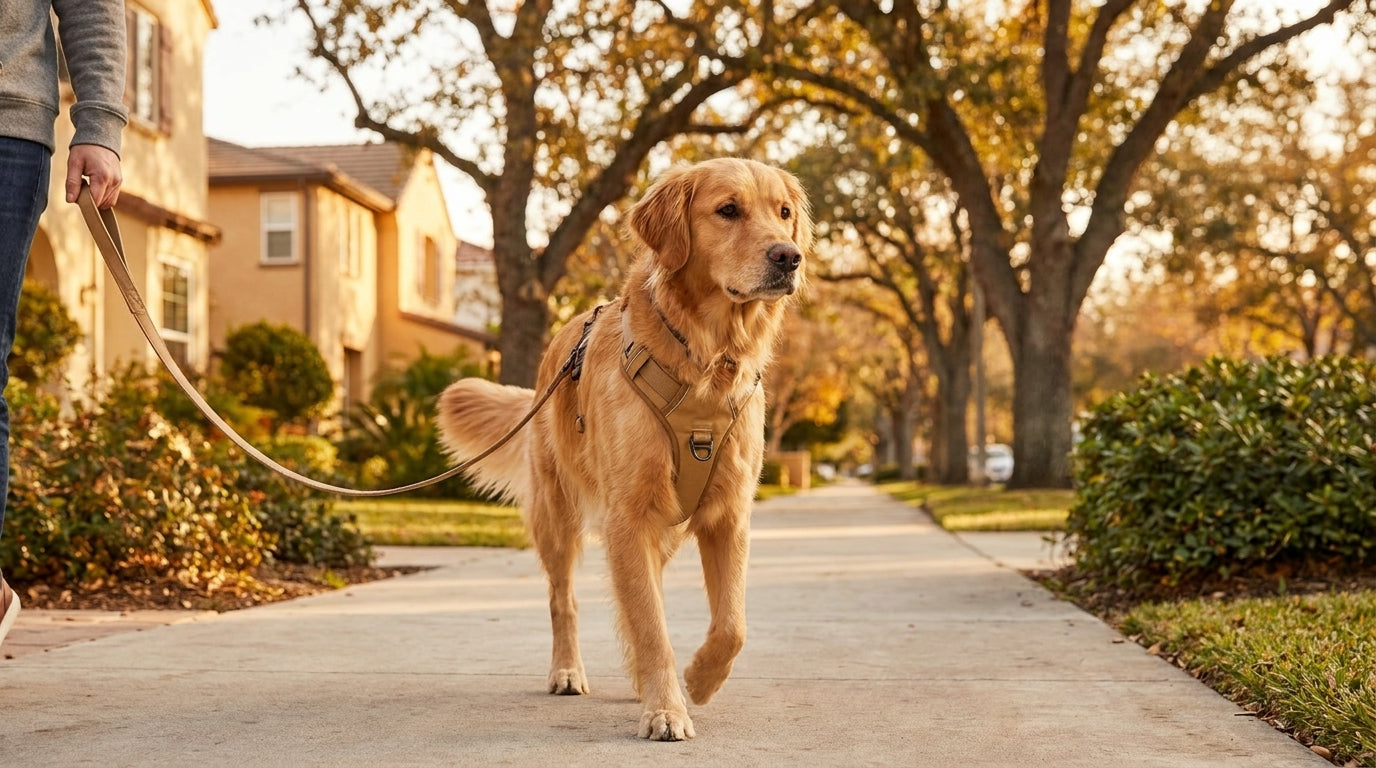
A typical neck collar transmits the full force of a 50-pound dog's lunge through a 1-inch strap pressed against the trachea, larynx, jugular veins, and cervical spine. Veterinary case literature describes the result with the dryness of a clinical observation: tracheal collapse, laryngeal cartilage damage, IOP spikes, cervical disc damage. The no-pull harness exists because the collar is the wrong tool for the dog who pulls.
What makes a harness no-pull (the mechanics)

"No-pull" describes a mechanical outcome, not a brand. The harness redirects forward force into a sideways or upward turn, breaking the opposition reflex without compressing the neck. Three structural designs deliver that outcome with different trade-offs. Reading the differences tells you which fits your dog's pulling style.

"Force spreads across the sternum and shoulder shelf, not the trachea. Front-clip attachment redirects forward pull into a sideways turn."
Mechanical redirection. The dog's own pulling becomes the cue to turn. Reduces leash tension by 60 to 80 percent in owner-reported data. Best for handler-led walks with active engagement.
Owner-reported pulling-reduction data, multiple controlled studies

"Back-clip step-in or vest-style harness. Comfortable, but reinforces the pulling reflex without front-clip redirection."
The opposition reflex is intact. The dog feels pressure on the chest and pushes forward, exactly as a sled dog would. Comfortable for the dog, frustrating for the handler. Use only for non-pullers.
Opposition reflex literature in canine behavior research

"Y-shaped chest strap conforming to sternum and clavicles. Dual clips (front + back) for technique-flexible use."
Anatomically correct: the Y-front follows the dog's natural shoulder geometry, leaving full range of motion. Dual-clip lets the handler switch between training mode (front) and casual mode (back). Best long-term option.
Lafuente et al., Veterinary and Comparative Orthopaedics, 2019
The 21-day fitting & adaptation protocol
A harness that arrives in a box on Monday is not a tool until it has been fitted, adapted, and broken in. The 21-day protocol below takes the dog from first wear to fully integrated.
Fitting & positive association
Low-distraction adaptation
Loaded walks & real-world
Choosing by size & breed
Size fit matters more than feature lists. Two-finger gap at every strap is the universal standard.
- Small dogs (under 25 lb). Y-front design protects fragile tracheas. Avoid step-in harnesses that wrap around the trachea. Pug-flat-face breeds need extra clearance at the throat.
- Medium dogs (25-60 lb). Y-front with dual-clip is the long-term fit. Front clip for training mode, back clip once loose-leash holds.
- Large dogs (60-100 lb). Reinforced stitching matters. Check the chest-plate buckle rating. Pulling forces scale exponentially with body weight.
- Puppies (under 12 months). Adjustable Y-front that grows two to three sizes. Re-check fit weekly during growth phases.
The right harness is the one the dog wears comfortably, you fit correctly, and you pair with the technique. Hardware without protocol is hardware. Pair both and the walk changes.
Harness types compared: which one fits which dog
| Feature | Y-front no-pull | Standard back-clip | Front-clip only | No-pull front+back combo |
|---|---|---|---|---|
| Pulling reduction | 40–70% in 2 weeks | None (often increases) | 40–60% | 50–80% |
| Ortho safety | Excellent (sternum spread) | OK | Variable (band style risky) | Excellent |
| Fit difficulty | Moderate | Easy | Hard | Hard |
| Escape risk | Low (2 clip points) | Moderate | Low | Very low |
| Return policy at FURMIND | 30 days, no questions | N/A | N/A | N/A |
Frequently asked questions
Do no-pull harnesses actually work?
Yes, with caveats. Front-clip and Y-front designs reduce pulling intensity 40 to 70 percent within 2 weeks of consistent use, by changing the mechanical feedback the dog experiences. The reduction is not training, it is physics. The caveat: fit matters more than design. Around 80 percent of "doesn't work" complaints in customer data trace back to wrong sizing or wrong adjustment.
What is the best no-pull harness for large dogs?
For dogs 60+ pounds, the Y-front geometry is non-negotiable. Band-style chest straps restrict shoulder extension and concentrate force on the wrong load area. Look for double clip points (front and back), wide sternum padding, hardware rated for the dog's body weight, and ideally a strap configuration that does not lock the shoulders at full pull.
What is the difference between front-clip and back-clip?
The clip is where the leash attaches. Back-clip harnesses attach above the shoulder blades, which is comfortable but reinforces forward pulling. Front-clip harnesses attach at the chest, so pulling rotates the dog sideways instead of forward. The rotational feedback is what reduces the pulling. Combination designs offer both clips so handlers can switch based on context.
How do I know if my no-pull harness fits?
The two-finger rule: you should be able to slide two flat fingers between every strap and the dog's body without resistance, and not three. The chest panel should sit below the trachea, not against it. The girth strap should sit just behind the front legs, not in the armpit. Lift the harness off after each walk for the first week and check the coat for rubbing.
Can puppies wear no-pull harnesses?
Yes, with refits every 4 to 6 weeks during the growth window. Avoid band-style chest straps for puppies of large or bloat-prone breeds, since restricted shoulder extension during growth can affect joint development. Plan for two harness sizes across puppyhood: one for 8 to 16 weeks, one for 16 weeks onward, then a third adult size if the dog grows past the second.
Will my dog learn to pull harder against a harness?
Against a back-clip harness, yes, this is well-documented (opposition reflex). Against a front-clip or Y-front design, no. The mechanical feedback (sideways rotation instead of forward propulsion) removes the reinforcement loop that creates the pulling habit. After 14 to 21 days of consistent use, most dogs stop testing the rotation and walk more loosely on their own.