
The advice you hear is to "tire your dog out." So you tire her out. She runs two miles. She plays fetch for 30 minutes. She does the figure-eight thing in the yard. She is now standing in the kitchen, panting, watching you, ready for more. The advice was right about the principle but wrong about the mechanism. You did not need to burn her body. You needed to burn her brain.
The three types of mental stimulation (and why most dogs only get one)

"Mental stimulation" gets used as if it refers to one thing. It does not. It refers to at least three distinct cognitive workouts, each engaging a different brain system, each producing a different kind of fatigue. Most owners deliver one category (usually puzzle toys) and wonder why their dog still has energy. A dog who gets all three across a week is a dog whose brain is fully worked.

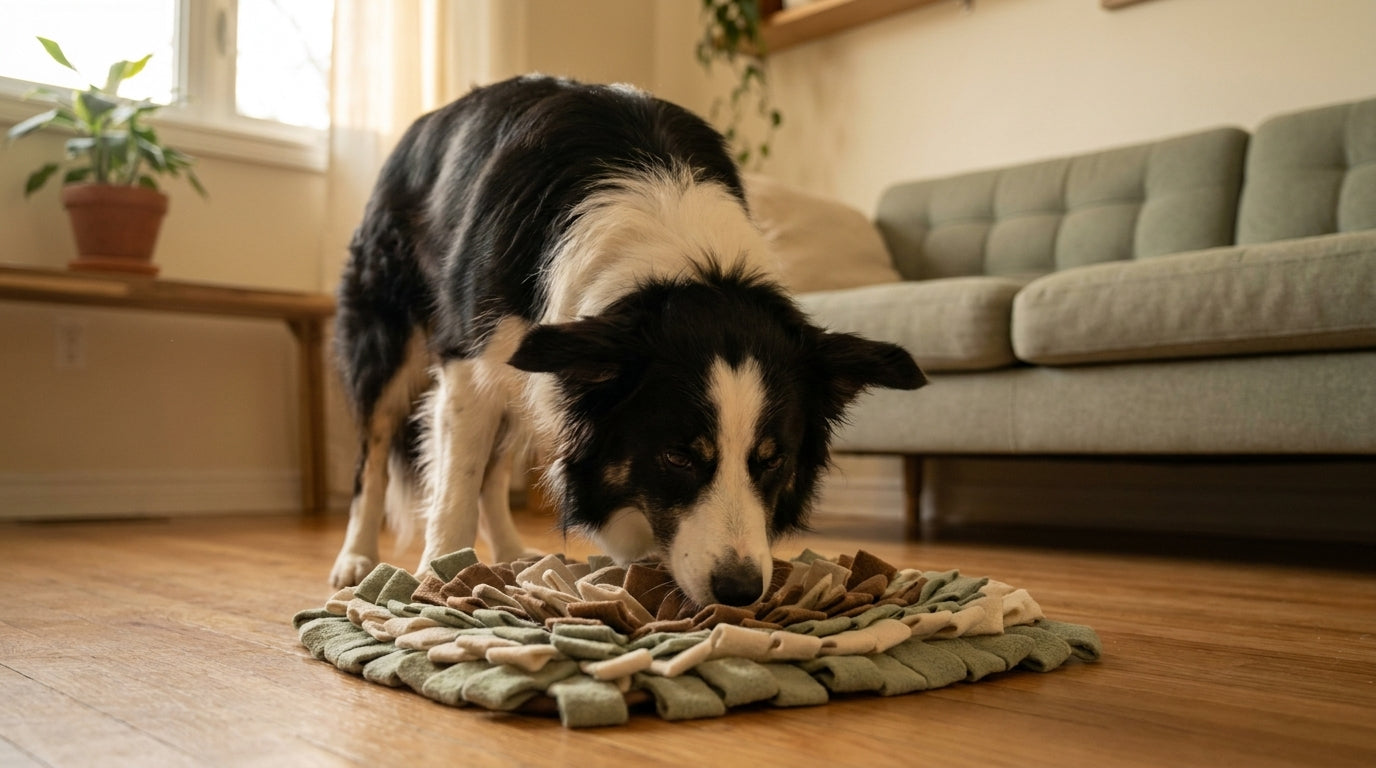
"Snuffle mats, scatter feeding, hidden food searches, scent tracking games. Activities that require the nose to do the work the eyes cannot."
Cerebral glucose depletion through olfactory processing, parasympathetic activation, dopamine-driven calm engagement. Highest fatigue per minute of any enrichment category. Resists habituation because each food and placement creates a new scent profile.
Horowitz, Inside of a Dog, 2009

"Puzzle feeders, treat-dispensing toys, lever puzzles, multi-step food extractions, find-it games with object permanence."
Planning, sequencing, frustration tolerance in small doses. Cortical engagement. Limit: most dogs solve a specific puzzle within 3 to 7 days, so rotation is mandatory. Owner-supervised because abandoned puzzles get chewed.
Bensky et al., Animal Cognition, 2013

"Wait-for-food drills, leave-it with progressively higher-value rewards, look-at-that reactivity protocols, structured stays."
Prefrontal-cortex-like inhibition, the closest analog dogs have. Produces the deepest sleep of any enrichment type. Reduces reactivity, leash pulling, and counter-surfing as a side effect of repeated practice.
McConnell, The Other End of the Leash, 2002
The 4-week mental enrichment rotation
One category is a habit. Three categories on rotation is a system. The math of cerebral glucose works across all three, so 20 to 25 minutes a day delivers most adult dogs their full cognitive load.
Foundation: daily olfactory work
Add problem-solving
Add impulse-control
Full rotation locked in
Adapt for your dog's profile
The 20 to 25 minute baseline fits most healthy adult dogs. Four groups need different scaling.
- Working breeds (border collies, Belgian malinois, German shepherds). Closer to 30 to 45 minutes of mental work daily. These dogs are bred for cognitive demand and underperform on smaller loads.
- Puppies (under 12 months). Shorter sessions of 5 to 10 minutes, 3 to 4 times daily, simpler difficulty. Puppy brains tire fast and need rest between cognitive blocks.
- Senior dogs (8+ large breeds, 10+ small). 10 to 15 minute sessions, focused on olfactory and gentle problem-solving. Regular cognitive work slows the progression of canine cognitive dysfunction in measurable amounts (Milgram et al., 2005).
- Anxious dogs. Olfactory and impulse-control work activate the parasympathetic system and generally help. Problem-solving puzzles can backfire because frustration compounds existing stress. Start with snuffle work, observe two weeks before adding puzzle complexity.
For every group, the principle is the same: scale to the dog. Cognitive enrichment is one of the highest-leverage interventions you can run, but only if the load matches what this dog can metabolize at this point in life.
Where to start, based on what your dog actually needs
| Dog profile | Start here | Add second | Add third |
|---|---|---|---|
| Bored, destructive, high-energy | Snuffle mat (olfactory) | Puzzle feeder (problem-solving) | Impulse-control drills (wait/leave it) |
| Anxious, reactive | Snuffle mat (calming + olfactory) | Light impulse-control (look at that) | Hold off on puzzle work until baseline drops |
| Senior with cognitive signs | Gentle olfactory (scatter feeding) | Easy snuffle mat sessions | Short find-the-toy games |
| Young puppy | Surface scatter + find-it | Short "wait" drills | Simple puzzles, supervised |
Frequently asked questions
How much mental stimulation does a dog need a day?
Most adult dogs need 20 to 30 minutes of structured mental work daily, in addition to physical exercise. Working breeds need closer to 45 minutes. Seniors and puppies benefit from shorter, more frequent sessions (10 to 15 minutes, multiple times per day). Quality of the work matters more than total time.
What is the best mental stimulation for dogs?
The best stimulation is rotation across three categories: olfactory (snuffle mats, scatter feeding), problem-solving (puzzle feeders), and impulse-control (wait/leave-it drills). Most owners deliver one category only and wonder why their dog still has energy. The three together cover what the brain actually needs.
Are puzzle toys enough mental stimulation for dogs?
No, for two reasons. First, dogs solve specific puzzles within days, and the cognitive load drops. Second, puzzle toys only engage one of the three categories. Rotation between categories matters more than the specific tool.
How long should I do brain games with my dog?
Start with 5 to 10 minutes for new activities. Build to 15 to 20 minute high-density sessions for healthy adults. Watch for over-enrichment signs (refusal, frustration, sleep changes). Mental fatigue is the goal; overload is not.
Is mental stimulation more important than physical exercise?
Different categories with different roles. Physical exercise provides joint, cardiovascular, social, and environmental benefits. Mental exercise produces calm at home. A dog needs both. The mistake is using one to substitute for the other.
Can mental stimulation help with destructive behavior?
In most cases, yes. Destructive behavior is often a discharge of unmet cognitive load. Replacing the discharge with structured mental work (snuffle, puzzle, impulse-control) resolves the underlying need. Most boredom-driven destructive behavior reduces visibly within 7 to 14 days of consistent enrichment.