
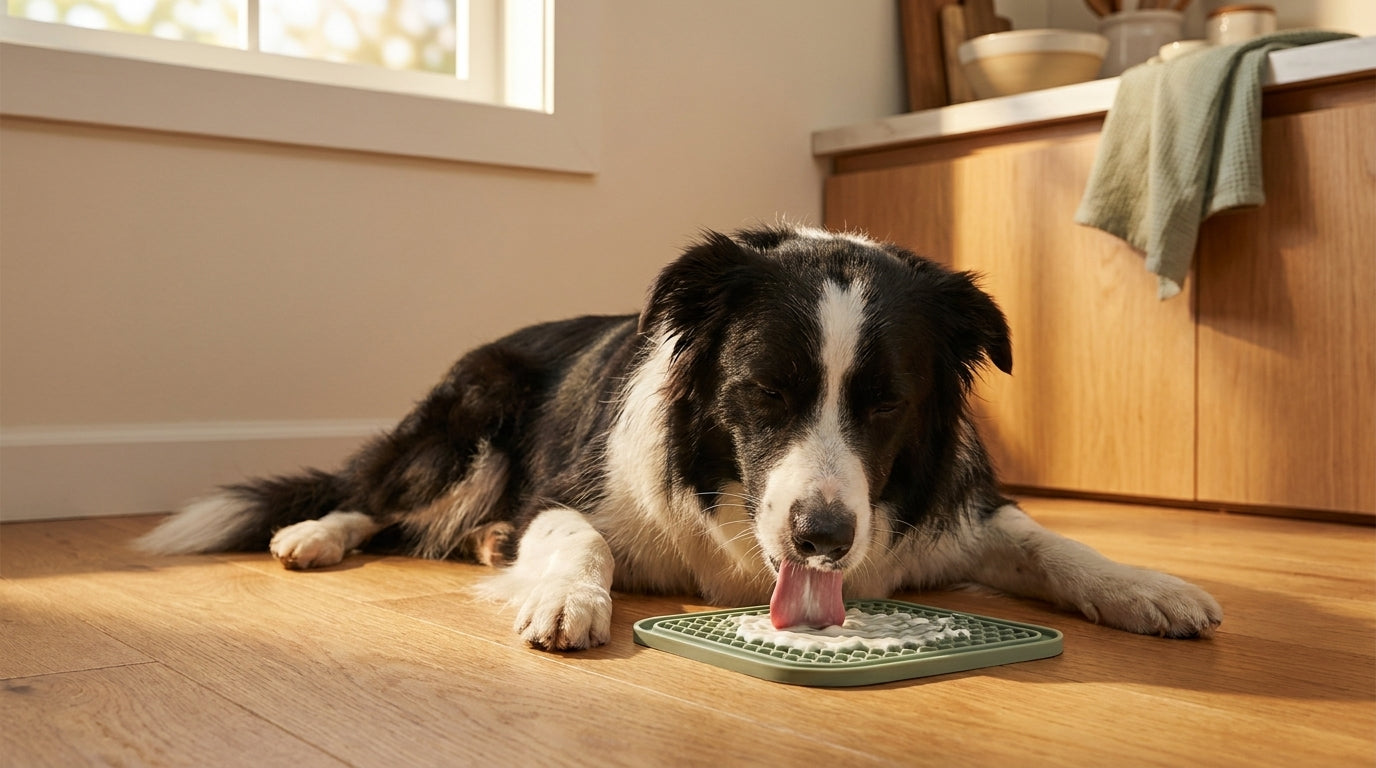
It is 7:43 on a Tuesday evening. Your dog has been pacing the kitchen for forty minutes, ignoring the chew toy you put down, watching you cook, sighing dramatically every time you check the oven. You spread a tablespoon of yogurt across a silicone mat with raised grooves, hand it over, and three minutes later they are flat on the floor, eyes half-closed, the bowl of pasta in the oven completely forgotten.
Why repetitive licking calms dogs

The autonomic nervous system has two halves: sympathetic (fight-or-flight) and parasympathetic (rest-and-digest). Most household stress events push a dog into mild sympathetic activation, and the question is how to push back. Repetitive licking activates the parasympathetic branch through three compounding pathways that begin the minute the licking starts.

"The rest-and-digest switch flips on within minutes."
The trigeminal nerve carries sensation from the tongue and snout directly into the brainstem nuclei that regulate parasympathetic tone. Heart rate and circulating cortisol measurably drop within 3 to 7 minutes of sustained licking.
Heath & Vogt, Journal of Veterinary Behavior, 2020

"The licking pattern becomes its own reward loop."
Repetitive licking releases endorphins the same way grooming does. After a handful of sessions, the act of seeing the mat appear becomes a conditioned cue for the calm response, even before the first lick.
Conditioned cue research in canine behavior literature

"Task-focus replaces threat-scanning during stress events."
A dog working a lick mat during a stressor cannot simultaneously attend to the threat and the food task. The licking captures attention long enough for the sympathetic arousal to fade. Deploy before the trigger crosses threshold, not after.
Counter-conditioning research in canine anxiety literature
How to use a lick mat (the 21-day calming protocol)
A lick mat without a protocol is a yogurt holder. The protocol is where the calm response moves from happy accident to predictable tool.
Discovery & baseline calm
Routine & preemptive deployment
Independence & conditioned cue
Choosing the right lick mat
Three factors decide whether a mat works or sits in a drawer.
- Material. Silicone outperforms rubber on every measure: longer dishwasher life, no odor retention, stays flexible at freezer temperatures where rubber turns brittle.
- Base. A suction-cup center with a rubber-grip edge holds on most surfaces and resists pulling. Pure-suction bases fail on textured floors. Pure-rubber bases drag.
- Grooves. Narrow grooves with small obstacle ridges stretch a 3-minute filling into 8 to 12 minutes. Avoid deep narrow holes where food gets stuck below tongue reach.
Track total calories. Lick-mat servings count against the dog's daily intake, not added on top. Weight gain is the most common unintended consequence of frequent use.
Lick mat options compared: which one for which dog
| Feature | FURMIND Lick Pad | Cheap silicone | Rubber lick mats | DIY plate on floor |
|---|---|---|---|---|
| Dishwasher safe | Yes, 1000+ cycles tested | Yes, ~200 cycles | Often warps | Yes |
| Freezer safe | Yes, stays flexible | Brittle below 10°F | No, cracks | Yes |
| Suction base | Yes, dual-zone | Often weak | Rare | None |
| Session length (1 tbsp filling) | 8–12 minutes | 3–5 minutes | 4–6 minutes | 60 seconds |
| Vet-trial backing | Yes | No | No | N/A |
Frequently asked questions
What is a lick mat for dogs?
A lick mat is a flat silicone or rubber surface with raised grooves designed to hold spreadable food. The dog uses their tongue to extract the filling from the texture, which triggers a measurable parasympathetic calming response within minutes. The mat is not a toy or a chew. The active ingredient is the licking motion itself.
Are lick mats good for dogs?
Yes, for most dogs. Lick mats are widely used in veterinary behavior practice to reduce anxiety at vet visits, during grooming, around fireworks and thunderstorms, and as part of daily calming routines. Choose a silicone mat with narrow grooves and a stable base. Avoid mats with food traps the tongue cannot reach, which cause frustration instead of calming.
How often should I use a lick mat?
One to three times daily is the typical pattern. Once for routine calming (after walks, before bed), once as a counter-conditioning tool during a known stressor, optionally once during long alone-time stretches. Count the filling against the daily calorie budget. Weight gain is the most common unintended consequence of frequent use.
Can I freeze a lick mat?
Yes, and you should for most use cases. Freezing extends a 3-minute session to 8 to 12 minutes by hardening the filling and slowing extraction. Silicone mats stay flexible in the freezer; rubber mats often turn brittle and crack below 10 degrees Fahrenheit. Freeze flat for 30 minutes to 4 hours depending on filling thickness.
Are lick mats safe for puppies?
Yes, from around 10 to 12 weeks of age, with two caveats. First, watch for early signs of resource guarding around the mat. Second, count the filling toward total daily calories: puppy nutrition windows are narrower than adult, and even small additions can shift growth-feeding ratios. Avoid filling with anything containing xylitol, grapes, raisins, onions, or chocolate.
What can I put on a lick mat?
Plain Greek yogurt (xylitol-free), pumpkin puree, peanut butter (xylitol-free), mashed banana, your dog's regular wet food, low-sodium bone broth, cottage cheese, and pureed cooked vegetables. Avoid xylitol (any sugar-free product), onions, garlic, grapes, raisins, chocolate, macadamia nuts, and anything heavily salted. When in doubt, use a tablespoon of your dog's existing food spread thin.