
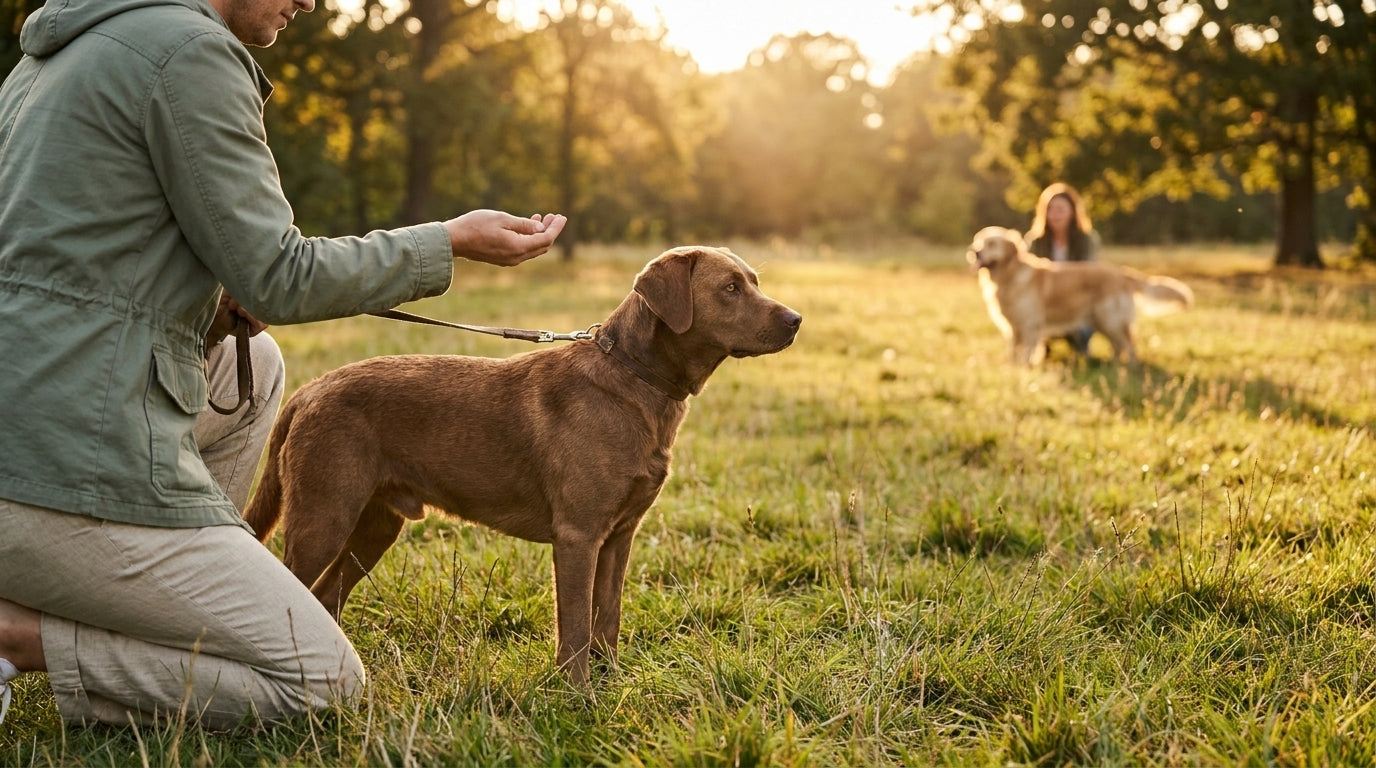
He sees the other dog from across the park. His body changes. The tail rises. The chest puffs forward. The pace stiffens. Before the other dog has even registered him, your dog is lunging into the leash with a bark that sounds nothing like the dog who naps on your lap.
What reactivity actually is (and why it is not aggression)

Reactivity is an overreaction to a trigger that produces a startle-fight-or-flight response in a dog who, off-leash, would not react the same way. The leash itself is part of the problem: it prevents the natural distance-creating moves dogs use to manage other dogs and triggers. The reactive display below clusters into three patterns. Reading the pattern tells you which protocol fits.

"Forward-charge response toward the trigger, often with stiff tail and forward weight shift. May resolve once the trigger passes or distance increases."
Frustration-driven reactivity. The dog wants to engage with the trigger but cannot due to the leash. Common in social dogs whose play-drive gets blocked. LAT (Look at That) protocol works well.
Donaldson, Mine!, 2002

"Sustained vocal threat display directed at the trigger, often with raised hackles and tense posture. Persists even after the trigger has passed."
Fear-driven reactivity. The dog is using distance-increasing signals because the trigger feels threatening. BAT (Behavior Adjustment Training) protocol fits this pattern. Counter-conditioning at sub-threshold distance.
McConnell, The Other End of the Leash, 2002

"Sudden immobility, often with weight shifted backward, ears pinned, tail tucked. May escalate to lunging if the trigger continues approaching."
Freeze response, the most under-recognized reactivity pattern. The dog is in shutdown, not calm. Treat this with caution: forced exposure makes it worse. Veterinary behaviorist consultation often warranted.
Overall, Clinical Behavioral Medicine, 2013
The 14-day threshold-distance protocol
The principle is the same across all three patterns: keep the dog below threshold while building positive associations with the trigger.
Find & mark threshold
LAT or BAT pairing
What slows down recovery
Three mistakes flatten the threshold curve.
- Working over threshold. Walking the dog into a reactive display because "we have to keep going." Every over-threshold incident reinforces the reactivity pattern. Cross the street, turn around, do whatever it takes.
- Punishing the display. Yanking, scolding, or alpha-rolling raises the dog's stress around the trigger. The display becomes more intense, not less.
- Inconsistent walkers. One handler runs the protocol, another walks at threshold-crossing distance. The dog cannot consolidate the new pattern. Every handler runs the same protocol or no one runs it.
If progress has stalled by day 14 despite consistent work, the pattern may be Tier 3 (freeze response) or co-morbid with generalized anxiety. Veterinary behaviorist consultation is the next step.
Match the reactivity level to the approach
| Level | What you see | Approach |
|---|---|---|
| Mild | Occasional reactivity to specific triggers (other dogs, bicycles). Recovers within minutes. Threshold around 40 to 60 feet. | LAT protocol at threshold. 14-day Walk Fix. Most cases resolve within 4 to 6 weeks. |
| Moderate | Daily reactivity across multiple trigger types. Threshold tight (10 to 30 feet). Recovery takes longer. Stress signs visible between walks. | Combined LAT and BAT. Threshold-respecting environment selection. Pre-walk parasympathetic reset. 8 to 12 weeks. |
| Severe | Cannot leave the house without reactivity. No safe distance achievable in typical environments. Cortisol baseline chronically elevated. | Veterinary behaviorist consultation. Likely pharmaceutical support. Protocol-based work after stabilization. |
Frequently asked questions
Is my dog aggressive or reactive?
Aggression involves stable intent to harm across contexts. Reactivity is situational stress overflow, usually leash-induced and proximity-driven. Most reactive dogs behave normally around the same triggers when the leash is removed or distance is increased. If the behavior disappears outside the trigger zone, it is reactivity, not aggression.
Why does my dog lunge at other dogs on a leash but not at the dog park?
The leash is the variable. On-leash, the dog cannot increase distance, cannot signal naturally, and is forced into proximity with the trigger. Off-leash, the dog can manage the encounter using normal canine signals. Many dog-reactive dogs are dog-social when leash pressure is removed.
Can leash reactivity be cured?
Resolved is more accurate than cured. With a threshold-respecting protocol like LAT or BAT, most dogs reach a state where the reactive behavior fades and normal walks become possible. The underlying sensitivity may always remain, but it stops driving behavior. Most cases resolve within 6 to 12 weeks of consistent work.
What is trigger stacking?
The cumulative effect of stressors within a short window. A dog stressed by a thunderstorm at 6 AM has a lower reactivity threshold at 2 PM than the same dog on a calm day. Reactive episodes often happen on bad days, not because the trigger changed but because the cortisol baseline was already elevated.
Should I avoid all my dog's triggers?
No. Complete avoidance prevents learning. The goal is controlled exposure at or above threshold distance. Strategic avoidance during bad days makes sense. Permanent avoidance just shrinks the dog's world without resolving anything.
What gear is best for a reactive dog?
Front-clip or Y-front harness (avoids tracheal pressure during sudden lunges), bungee leash (absorbs impact spikes that intensify reactivity), no head halti or aversive gear (raises cortisol, worsens the underlying pattern). The Pre-Walk Reset Protocol explains the gear-plus-routine combination that lowers reactivity floor before each walk.