
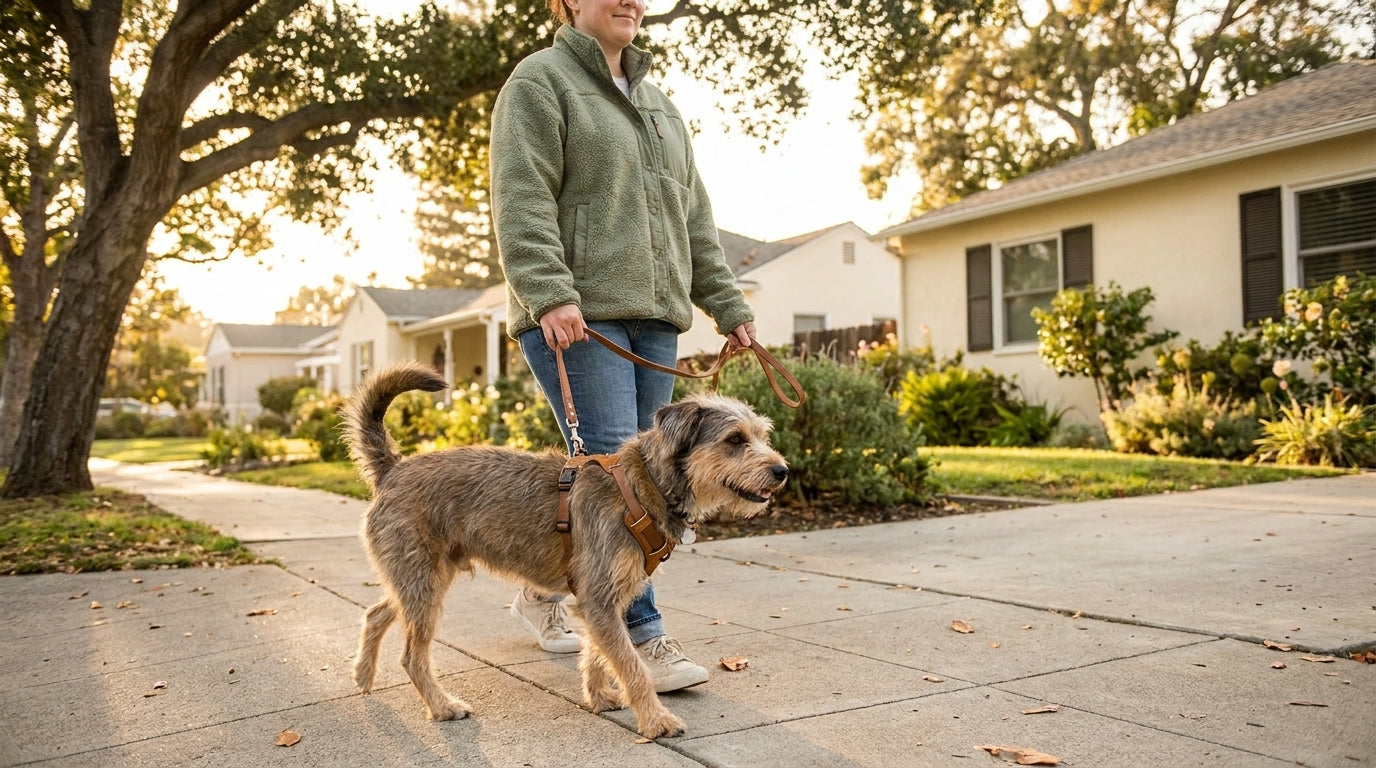
The leash is taut. Has been taut for twenty minutes. Your shoulder feels it. Your dog does not seem to. She is fifteen pounds heavier than the last harness fitting, and yet here you are again, leaning back like you're skiing downhill while she leans forward like she's pulling a sled.
Why dogs pull (the opposition reflex)

Pulling is not defiance. It is a hardwired reflex called negative thigmotaxis: when the dog feels pressure against the body, the body pushes back into the pressure. The harder the leash pulls, the harder the dog pulls forward. Three evidence-based techniques interrupt the reflex without escalating the force. None of them rely on punishment, all of them require consistency.

"The walker stops the moment the leash goes taut. Stands still. Waits for the dog to release pressure. Walks again only when the line goes slack."
Breaks the opposition reflex by removing forward motion as a reward for tension. The dog learns that pulling stops the walk. Slack restarts it. Slow but durable.
McGreevy & Boakes, Carrots and Sticks: Principles of Animal Training, 2007

"The walker turns and walks the opposite direction the moment the leash goes taut. Dog follows. After three or four turns, the dog checks in before pulling."
Removes the direction the dog is choosing. Trains the dog to track the handler's pace rather than the destination. Faster than stop-go, requires more handler attention.
Hiby et al., Animal Welfare, 2004

"A verbal marker (the word 'red-light' or 'easy') paired with a high-value treat the moment the dog releases tension on the leash."
Adds a positive marker for slack-leash behavior. Faster than stop-go and turning, but requires treat readiness throughout the walk. Best paired with one of the other two techniques.
Pryor, Reaching the Animal Mind, 2009
The 14-day pulling reduction protocol
Two weeks of consistent practice changes the walk. Most dogs hold loose-leash behavior 80 percent of the time by day 14.
Equipment & signals
Real-world generalization
Gear that helps versus gear that quietly hurts
Equipment matters less than technique, but the wrong gear can sabotage the protocol.
- Y-front harness with front clip. Distributes force across the sternum, redirects forward pulling into a sideways turn. Pairs well with all three techniques above.
- Shock-absorbing bungee leash. Absorbs sudden lunges, protects the dog's neck and your shoulder. The most underrated piece of walking equipment.
- Flat collar with leash attached. Compresses the trachea under tension. Avoid for any dog who pulls. A collar carries ID, not the walk.
- Retractable leash. Teaches the dog that pulling extends the line. The opposite of what the protocol is trying to install.
- Prong or choke collars. Suppress pulling through pain. Behavioral evidence shows they raise fear and aggression rates, not reduce them. AVSAB recommends against routine use.
The combination that works for most pullers: Y-front harness, shock-absorbing bungee leash, one of the three techniques above, run with consistency.
Which technique fits your dog?
| Dog profile | Best starting technique | Why |
|---|---|---|
| Steady, food-motivated, calm walker who only occasionally pulls | Reward-marker pacing | High learning rate, low frustration. Builds clean loose-leash habit fast. |
| Excitable, high-energy, distractible | Direction change | Channels excitement into following the walker's movement. Pace stays high. |
| Strong puller, mechanically fixated, ignores food | Stop-and-go + front-clip harness | Removes the mechanical reward of pulling. Gear handles what training cannot reach alone. |
| Anxious or reactive walker who pulls toward home, not forward | Pre-walk reset + structured walking | Lower the arousal baseline first. Then introduce structured walking technique. |
Frequently asked questions
How long does it take to train a dog to walk on a leash?
Most dogs show measurable improvement within 7 to 14 days of consistent training. Full loose-leash walking on busy walks typically takes 4 to 8 weeks. The variable is consistency, not the dog. Inconsistent training extends the timeline indefinitely.
What is the best technique to stop a dog from pulling?
For most dogs, stop-and-go combined with a front-clip harness or shock-absorbing leash produces the fastest results. The technique works because it reverses the reinforcement pattern. Pulling now stops motion instead of producing it.
Do no-pull harnesses actually work?
Front-clip and Y-front no-pull harnesses reduce pulling by 60 to 80 percent for most dogs, according to controlled trials. They work as mechanical aids, not as standalone solutions. The dog still needs the underlying training to make the change permanent.
Should I let my dog sniff while walking?
Yes. Decompression sniffing is one of the highest-value enrichment activities of a walk. Schedule it: structured walking sections with loose-leash expectations, alternating with sniff zones where the dog is allowed to lead. The contrast actually improves the structured sections.
How do I get my puppy to stop pulling?
Start training before pulling becomes a strong habit. Puppies under 6 months learn loose-leash walking in 2 to 3 weeks with consistent stop-and-go. Use a properly-fitted Y-front harness, not a collar, to avoid tracheal pressure on a developing dog.
Why does my dog pull more on the way back from a walk?
Most dogs pull toward home because home is the highest-value destination. The reinforcement of returning home is greater than any training reward you can offer mid-walk. Address this by sometimes ending walks somewhere other than home, or by lengthening the home stretch into a slow, structured walking section.