
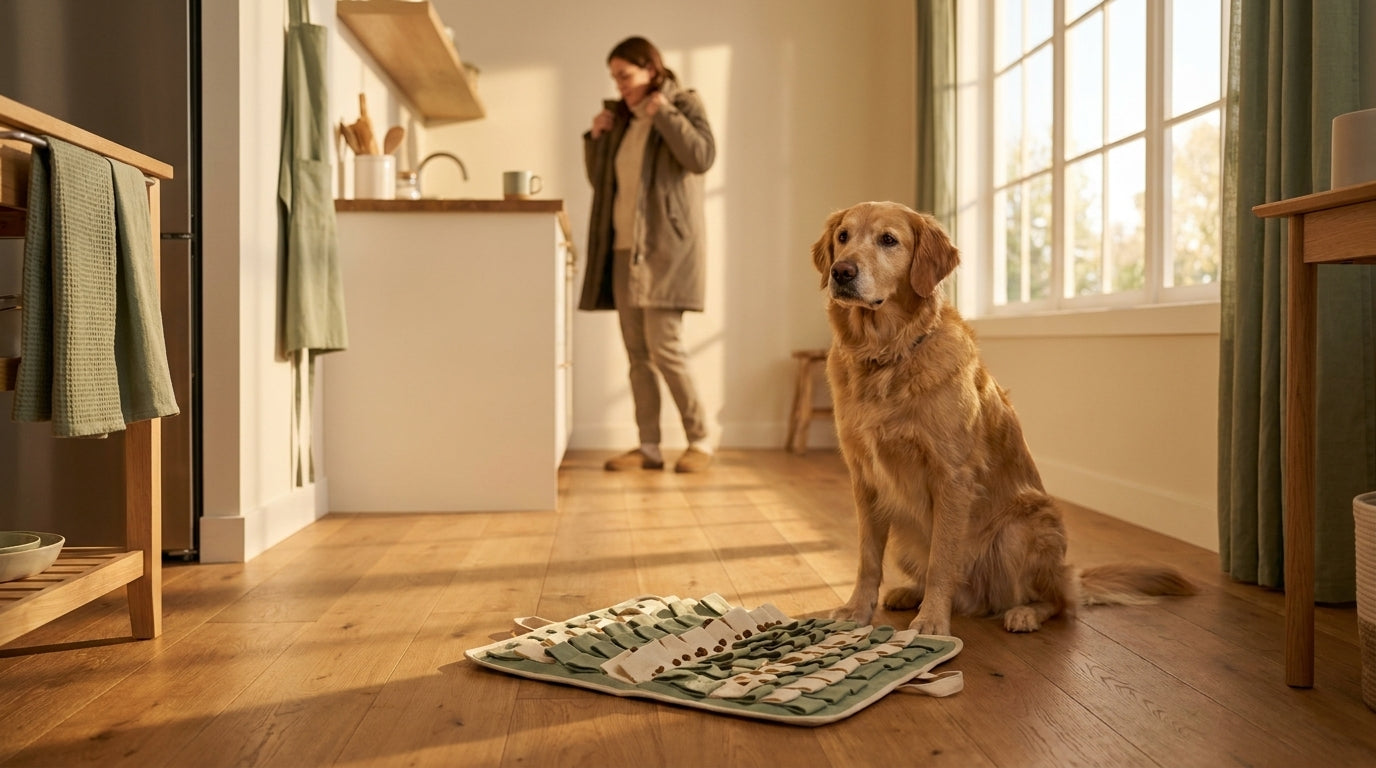
It is 8:14 AM. You leave for work at 8:30. You have walked her, played with her, and put her food down twenty minutes ago. She is now standing in the kitchen, watching you make coffee, ready for the next thing. The next thing is you walking out the door for nine hours.
Why tiring them out before you leave usually does not work

Physical exhaustion does not metabolize the same way cognitive engagement does. A pre-departure walk burns calories and lowers acute energy, but it does nothing for the eight-hour stretch where the brain has nothing to do. Boredom-driven destruction, vocalization, and pacing are cognitive symptoms. The three at-home tools below produce sustained engagement across the day, deployed in rotation rather than at a single peak.

"A snuffle mat loaded with the dog's lunch portion (kibble or freeze-dried food). The dog forages for 10 to 15 minutes, then naps."
Cerebral glucose depletion via olfactory work delivers the highest fatigue-per-minute of any home enrichment. Replaces a feeding event with a cognitive one. Best for bored, hyperactive young dogs and working breeds.
Horowitz, Inside of a Dog, 2009

"A lick pad with peanut butter, plain yogurt, or pureed banana. Deploy at mid-morning, after lunch, or when the dog starts asking for engagement."
Vagal-nerve stimulation produces parasympathetic calm within 5 to 10 minutes. Frozen filling extends the session. Best for anxious dogs and dogs prone to mid-afternoon vocalization.
Mariti et al., Journal of Veterinary Behavior, 2018

"Hand-scatter dry kibble across a rug, low-pile carpet, or grass. Dog uses scent to recover each piece. Zero equipment required."
Backup tool when snuffle mat is dirty or unavailable. Produces 60 to 70 percent of the snuffle mat's cognitive load. Best for any dog as the daily floor of engagement when other tools are not in rotation.
Bradshaw, Dog Sense, 2011
The 4-week staggered engagement protocol
One tool deployed at 8 AM does not last until 5 PM. Three tools cycled across the day, layered into a 4-week pattern, do.
Baseline ritual: morning snuffle
Add mid-day lick pad
Add scatter feeding backup
Full rotation locked in
When boredom looks like anxiety (and vice versa)
The behaviors overlap but the protocols differ. Read the cues before locking in a tool.
- Boredom destruction targets variety. Chewed shoes, scattered trash, rearranged couch cushions. The dog is choosing the activity. Cognitive enrichment usually resolves it within 2 to 3 weeks.
- Anxiety destruction targets exits. Door frames, window sills, the spot you last stood. The behavior is panic-driven. Enrichment helps as adjunct, but desensitization is the primary protocol (see our separation-anxiety guide).
- Boredom vocalization is intermittent. Barking starts, stops, starts again when nothing new happens. Enrichment fills the silence.
- Anxiety vocalization is sustained. Continuous whining or howling, often with appetite loss. Vet consultation before tool changes.
If the protocol above does not produce visible change by week 3, re-evaluate. The dog may not be bored. The behavior may need a different protocol.
Is your dog bored or anxious?
| Sign | More likely boredom | More likely anxiety |
|---|---|---|
| Destruction location | Varies across rooms | Concentrated at exit points |
| Vocalization during absence | Occasional, low-key | Sustained, panicked |
| Physical signs (drool, panting, accidents) | Rare | Present |
| Engagement with loaded enrichment | Yes, within minutes | No, refuses food |
| Behavior on return | Resumes normal quickly | Sustained over-excitement or withdrawal |
Frequently asked questions
How do you keep a dog entertained at home all day?
Staggered enrichment: 2 to 3 short engagement units distributed across the absence, rather than one long pre-departure session. Snuffle mats at mid-morning, frozen lick pads at early afternoon, scatter feeding at late afternoon. The dog sleeps between sessions and engages with fresh activities at each wake cycle.
What do you do with a dog when working from home?
Same principle, with the addition of structured "off duty" times when the dog has its own enrichment activity while you focus on work. Train a settle-on-mat behavior so the dog has a clear default. Two 15-minute work-the-mat sessions per day cover most adult dogs' needs in this context.
How do I keep my dog from getting bored in an apartment?
Apartments are not a disadvantage for mental enrichment. Most enrichment activities (snuffle mats, scatter feeding, puzzle feeders, lick pads, find-the-toy games) require no outdoor space. The cognitive fatigue from 15 minutes of olfactory work in a 600-square-foot apartment is the same as in a 4-acre yard. Physical exercise needs different planning (more frequent walks, off-leash playdates), but mental work is location-independent.
Is it cruel to leave a dog home alone for 8 hours?
Not inherently. Adult dogs handle 8-hour absences with appropriate enrichment and routine. The cases where 8-hour absences become problematic involve separation anxiety, untreated boredom, or insufficient morning and evening engagement to bracket the absence. The structure matters more than the absolute number of hours.
What can I give my dog to keep him busy for hours?
No single item produces hours of engagement. Frozen lick pads (20 to 40 minutes), snuffle mats (15 to 20 minutes), long-lasting chews (15 to 60 minutes), and puzzle feeders (10 to 20 minutes) each deliver one session. The "hours" come from sequencing them across the absence, not from finding one magical tool.
Will leaving the TV on help keep my dog entertained?
Sound dampens external triggers and provides background stimulation, but it does not produce cognitive fatigue. It helps mildly anxious dogs by masking street noise. It does not replace enrichment activities that require the dog's active participation.