
It is 7:47 PM on the Fourth of July. Your dog has not eaten her dinner. She is in the closet, the closet you did not know she knew about. You can hear her panting from the hallway. Tomorrow morning she will emerge with chemical exhaustion in her eyes, leave the house briefly to eat grass, and sleep for sixteen hours.
What anxiety actually is in dogs (the parasympathetic story)

Most owners treat anxiety as a behavior to correct. It is not. It is a physiological state sustained by the autonomic nervous system: sympathetic branch stuck on, cortisol elevated, heart rate baseline shifted upward. You cannot discipline a cortisol cascade. You can only activate the parasympathetic branch and let it do its job. The three documented entry points below stimulate the vagus nerve and produce measurable calm within 5 to 10 minutes (Mariti et al., 2018).

"Repetitive licking on a textured surface coated with a soft food."
Direct vagal nerve stimulation. Measurable heart-rate reduction within 5 to 10 minutes. Most effective when used preventively, before the trigger event. Lowest cost-per-use of any calming intervention with comparable clinical effect.
Mariti et al., Journal of Veterinary Behavior, 2018

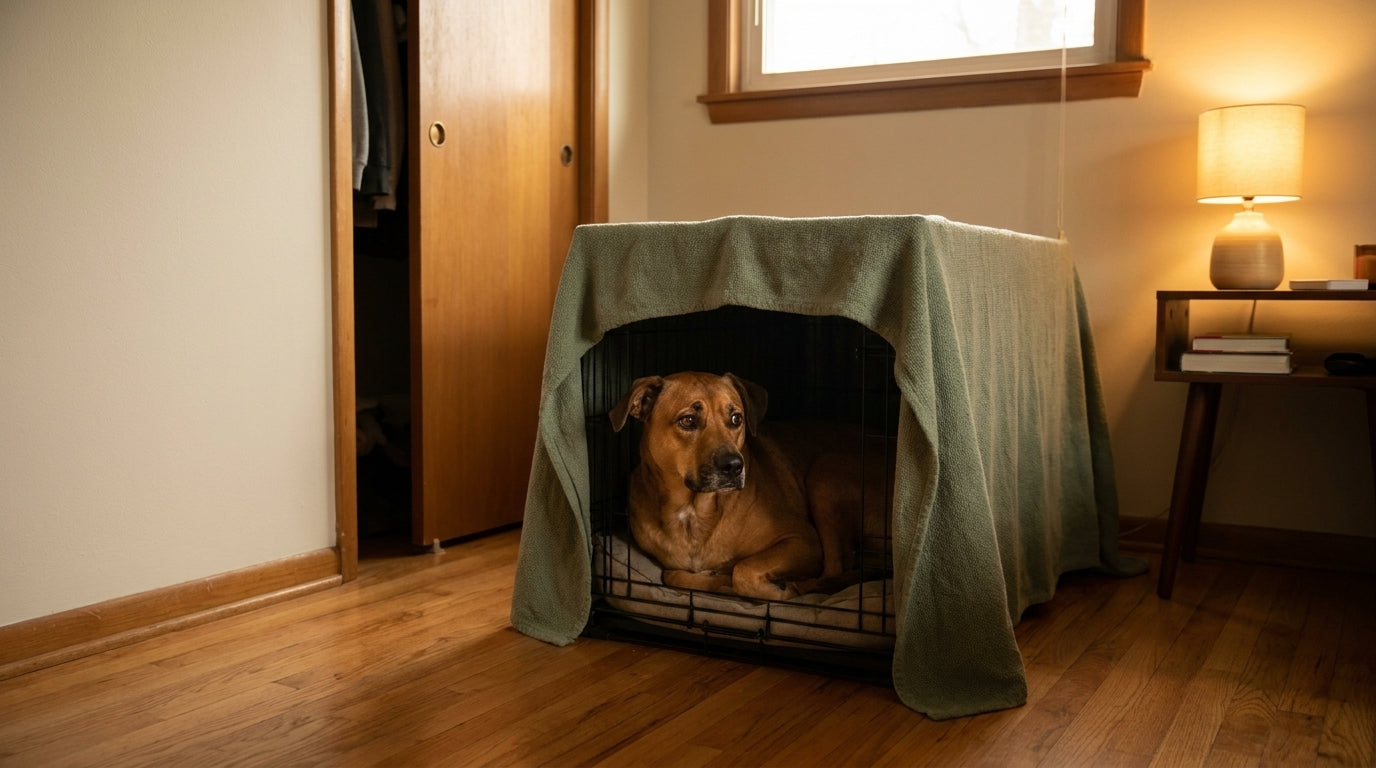
"A covered crate or den-style enclosure placed in a low-stimulation room."
Reduces sensory load by limiting visual triggers and dampening sound. Works through choice, not confinement. The dog enters voluntarily. Most underused intervention by owners. Costs nothing once the crate is in place.
American Veterinary Society of Animal Behavior, 2022 position statement

"A snug-fitting vest that applies steady, gentle pressure across the torso."
Mild calming effect for some dogs, no measurable effect for others. Roughly 30 percent response rate in controlled trials. Worth a try, not a primary tool. Use alongside a tier-one method, not instead of one.
Pekkin et al., Veterinary Record, 2016
The 21-day calming protocol
One method on its own is a tool. The protocol is what turns the tool into a baseline change. The 21-day arc moves from discovery to routine to conditioned cue.
Discovery & baseline calm
Routine & preemptive deployment
Independence & conditioned cue
Natural remedies versus medication
The clinical literature is clear on which interventions to lead with, and when prescription medication earns a seat.
- Start with behavioral methods. Vagal-stimulation tools (lick pad, snuffle work), environmental control (covered den, sound dampening), and counter-conditioning carry the strongest evidence base and the lowest side-effect profile.
- Supplements have mixed data. L-theanine and alpha-casozepine show modest effect in subsets of dogs. Worth trying as adjuncts, not as a substitute for the protocol.
- Prescription medication earns a role when anxiety is severe. Trazodone, fluoxetine, and situational agents (alprazolam, gabapentin) are evidence-backed when behavioral work alone is not enough. A veterinarian or veterinary behaviorist signs off.
- Avoid CBD as a primary tool. The evidence for dog anxiety remains thin. If you want to try it, run it past your vet and treat it as experimental.
The order matters. Behavioral and environmental tools first. Supplements as adjuncts. Medication when the baseline anxiety crosses what behavioral work can reach alone.
What level of anxiety does your dog have?
| Level | What you see | What to do |
|---|---|---|
| Mild (situational) | Brief fearful response to specific triggers (storms, fireworks, vet visits). Recovers within hours. Normal appetite between events. | Tier-one behavioral interventions. Start with lick mat preventive sessions before triggers. Expect improvement in 14–30 days. |
| Moderate (daily) | Hypervigilance most days, shallow sleep, appetite irregular, response to multiple contexts. Baseline cortisol clearly elevated. | Tier-one behavioral interventions plus veterinary consultation about short-term pharmaceutical support. Plan for 30–90 days of layered work. |
| Severe (chronic) | Panic-level responses, possible self-injury, behavioral collapse, social withdrawal, weight changes. | Veterinary behaviorist consultation, not an article. This level is outside what at-home interventions can address alone. |
Frequently asked questions
How do you actually calm an anxious dog in the moment?
Activate the parasympathetic branch. A frozen lick mat with peanut butter or yogurt works for most dogs within 5 to 10 minutes. If your dog is too dysregulated to engage with food, environmental management (covered crate, white noise, removed visual triggers) comes first. Pure reassurance and physical comforting tend to be less effective than they feel.
What is the best calming aid for dogs?
There is no single best. The most effective intervention is the one that matches your dog's anxiety level and trigger profile. For mild-to-moderate anxiety, parasympathetic activation tools (lick mats, snuffle mats) have the strongest evidence base for the cost. For moderate-to-severe anxiety, behavioral tools combined with veterinary-prescribed medication outperform either alone.
Do natural remedies actually work for dog anxiety?
Some do, in specific ways. Pheromone diffusers, L-theanine supplements, and music therapy have modest measurable effects. They are useful as additions to a primary intervention. They are not strong enough on their own for moderate or severe anxiety. CBD and aromatherapy have weaker evidence and require caution about product quality and dog-toxic ingredients.
Can I give my dog something to calm them down quickly?
For short-term acute anxiety, prescribed situational medications (trazodone, gabapentin) work within 60 to 90 minutes. Over-the-counter options like Benadryl or melatonin have limited effect and unpredictable dosing for dogs. Always consult your vet before administering anything, including supplements.
How long does it take to calm an anxious dog?
The in-the-moment response window is 5 to 10 minutes with parasympathetic activation. The deeper baseline reduction takes 14 to 30 days for mild cases, 30 to 90 days for moderate. Most owners abandon their methods too early. The 21-day point is often when the compound effect becomes visible.
Is dog anxiety a training problem?
No. Anxiety is a physiological state, not a behavior pattern. Training can teach a dog new associations, but it cannot directly lower cortisol. Training combined with parasympathetic activation and environmental management is what produces lasting change. Discipline alone often makes anxiety worse by adding a stress source.