
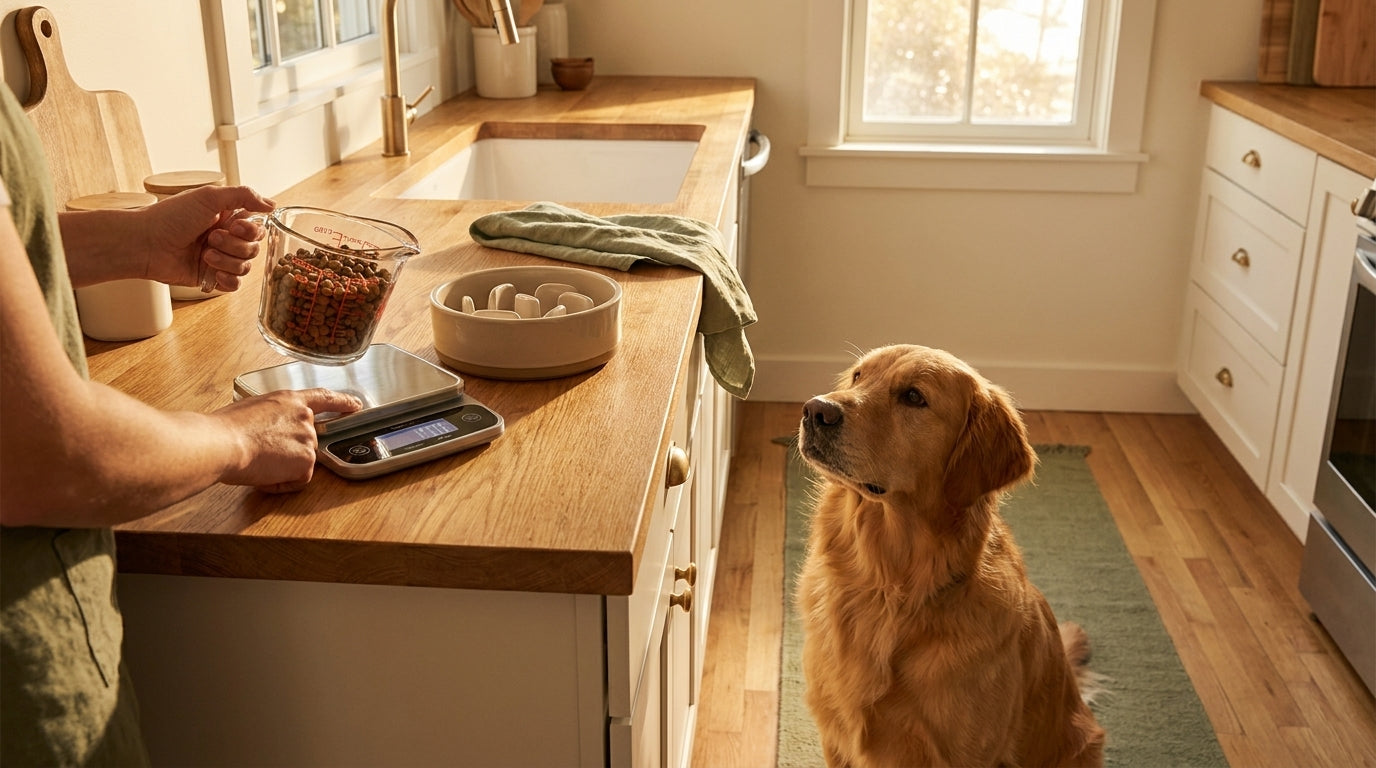
You flip the dog food bag over. There is a chart. Dogs from 10 to 30 pounds: 1 to 2 cups. Dogs from 30 to 50 pounds: 2 to 3 cups. Your dog is 42 pounds. You measure 2.5 cups, twice a day. This is what the bag said, so this is what you do.
Why the bag's feeding chart is usually wrong

The bag chart targets the population, not your dog. It assumes a healthy adult dog at moderate activity with no individual variation. Real calorie needs swing across three factors that the chart cannot see. Reading those factors gives you a number that fits your dog instead of the dog on the bag.

"The starting point for all caloric math. Weigh accurately on the same scale, monthly. Use kilograms for the formula (pounds divided by 2.2)."
A 20 percent change in body weight changes resting energy requirement by roughly 16 percent. Small weight changes do not require large feeding changes. Weigh monthly, not daily; daily fluctuations are noise, monthly trends are signal.
National Research Council, Nutrient Requirements of Dogs and Cats, 2006

"True activity, not perceived activity. Daily walks of 30 minutes at moderate pace count as low to moderate, not high. Fetch sessions or off-leash play time count as moderate. Working dogs or sport-active dogs count as high."
Activity factor varies from 1.0 (sedentary, weight loss target) to 3.0 (working dog). The same body weight can produce a 3x range in feeding amount. Owners systematically over-estimate their dog's activity level.
Hand, Small Animal Clinical Nutrition, 2010

"A 1-to-9 scale where 4 or 5 is ideal. You should be able to feel ribs easily without pressing through fat, and see a waist when viewed from above. Most dogs in clinical assessment are BCS 6 or 7."
If BCS is above ideal: reduce calculated maintenance by 10 to 20 percent for 6 to 8 weeks, reassess. If below ideal: increase by 10 to 20 percent. BCS shifts faster than the scale does in many cases; use both.
Laflamme, Canine Practice, 1997 (original BCS scale)
The 21-day calibration protocol
Finding the right portion is not a one-meal decision. The 21-day arc moves from baseline measurement to calibrated portion to a feeding amount that holds.
Baseline measurement
Adjusted feeding
BCS recheck & lock
One meal or two? (And other common feeding questions)
The portion is the main variable. Four secondary decisions matter less, but the wrong call on each still flattens the calibration.
- Two meals beats one meal. For most dogs, twice daily reduces hunger swings and supports steadier energy. One large meal raises GDV risk in deep-chested breeds.
- Measure with the cup, not the scoop. Coffee mugs, ice cream containers, and "the scoop in the bag" all carry portion errors of 30 to 50 percent. Use a measuring cup or a kitchen scale.
- Treats count. Treats above 10 percent of daily calories distort the math. Track them like food, not separately.
- Slow feeders for fast eaters. Same portion, more time. Reduces gulping and air-swallowing. Pairs naturally with the calibration protocol.
The bag chart is a starting estimate. Your dog's body weight, honest activity, and BCS are the calibration signal. Three weeks of structured observation replaces years of guessing.
What to adjust based on what you see
| What you observe | What to do |
|---|---|
| Weight stable, BCS ideal, energy good | Continue current amount. Recheck quarterly. |
| Weight climbing, BCS above ideal | Reduce daily amount by 10%. Reassess in 4 weeks. |
| Weight dropping, BCS below ideal | Increase daily amount by 10%. Rule out medical cause if drop is rapid. |
| Excessive begging, food motivation high | Likely behavioral, not nutritional. Try slow feeder + structured meal times. |
| Sluggish, low energy, dull coat | Could be insufficient calories OR diet quality. Increase amount 10% and reassess; if no change, evaluate food quality. |
Frequently asked questions
How many cups of food should I feed my dog per day?
Depends on weight, activity, and metabolic rate. As a starting point: small dogs (under 20 lb) typically need 0.5 to 1.5 cups per day; medium dogs (20 to 50 lb) need 1.5 to 3 cups; large dogs (50 to 90 lb) need 3 to 4.5 cups. These are rough ranges only. Use the MER calculation in this article for an accurate starting amount, then calibrate over 4 to 6 weeks.
Should I feed my dog once or twice a day?
Twice a day is the standard recommendation for most adult dogs. Lower meal volumes reduce digestive stress and gastric distention risk, and improve blood glucose stability. Three meals for puppies. One meal works for some adult dogs but is not optimal as a default.
How do I know if my dog is overweight?
Body condition score (BCS) on a 1-to-9 scale. At ideal BCS (4-5), you can easily feel the ribs without pressing through fat, see a waist when viewed from above, and see a tummy tuck when viewed from the side. Most dogs in clinical assessment are BCS 6 or 7 (overweight). Photos from above and side help track changes.
Why does my dog always seem hungry?
Most healthy adult dogs are not actually hungry in the medical sense; they are food-motivated. Begging persists because it has been historically rewarded with food. The 10 percent treat rule and predictable meal times reduce the begging cycle. Genuine hunger from undernutrition produces weight loss and energy changes; food-motivation alone does not.
Should I free-feed my dog?
Most adult dogs do not self-regulate well and overeat when food is available all day. The result is weight gain. Structured meals (twice daily, measured amount) work better for most dogs. The exceptions are typically lower-energy, lower-food-motivated dogs that show no weight gain on free-feeding.
Does my dog need a different diet for weight loss?
Usually not. A 10 to 20 percent reduction from current intake, combined with the same food, produces weight loss in most cases. Specialty weight-loss diets become useful when standard reduction alone is insufficient or when there are concurrent health conditions. Veterinary consultation is appropriate for significant weight loss goals.