
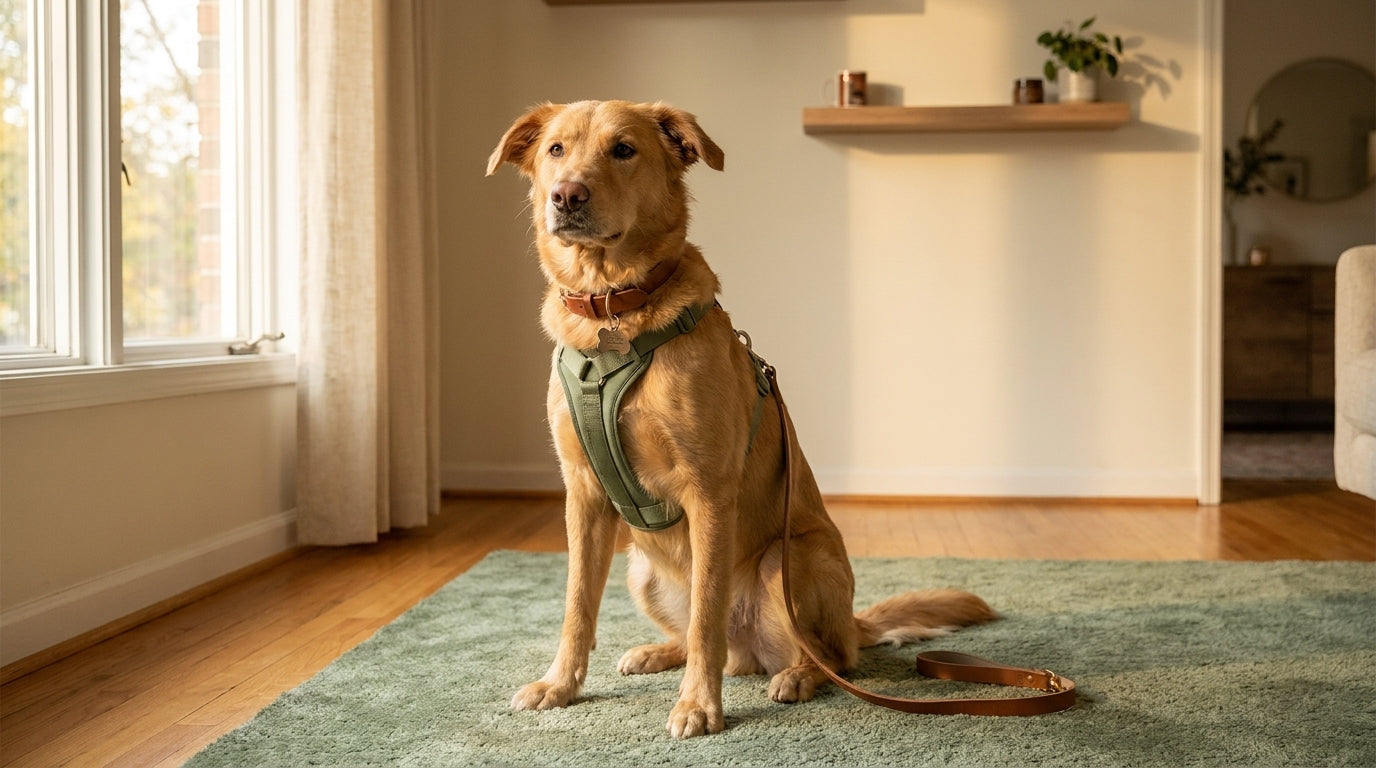
Your dog wears a flat collar. Has worn one since the day you brought her home. This is what dogs wear. It holds the ID tag, it holds the rabies tag, it occasionally holds your hand when she lunges for a squirrel. The question of whether it is the right tool for the walk almost never comes up, because it is the only tool most owners have considered.
What collars actually do to a dog's body

The veterinary literature is dry about this. A flat collar transmits the dog's pulling force through a one-inch strap pressed against the trachea, larynx, jugular veins, and cervical spine. For non-pullers this is unremarkable. For pullers it is measurable damage over time. The three configurations below cover the realistic options, with their mechanical trade-offs spelled out.

"Standard nylon, leather, or fabric collar with buckle or quick-release. Holds ID and rabies tags. Leash attaches directly to the collar ring."
Force concentrates on the trachea and cervical spine. Documented increases in intraocular pressure during pulling events. Tracheal collapse risk in small breeds and brachycephalic dogs. Functional for ID, harmful for the walk.
Carter et al., Journal of Small Animal Practice, 2020

"Strap configuration around the chest with the leash attachment between the shoulders or on the back of the body."
Force spreads across the chest, removes neck compression. But back-clip placement reinforces the opposition reflex by giving the dog a fixed point to push against. Better than a collar, not a no-pull tool.
Lafuente et al., Veterinary Orthopaedics, 2019

"Y-shaped chest strap that follows the natural geometry of the dog's shoulders and sternum. Front and back clip points for technique-flexible use."
Force distributes across the sternum and shoulder shelf without restricting gait. Front clip redirects pulling into a sideways turn. Anatomically correct, mechanically effective. The long-term right answer for most walks.
Lafuente et al., Veterinary and Comparative Orthopaedics, 2019
The 21-day transition protocol
Switching the dog from collar to harness is not a same-day decision. The transition runs as a 21-day adaptation arc.
Harness fitting & pairing
Switch leash to harness
Generalize to all walks
Common harness mistakes (that read like the harness does not work)
The harness performs only if four basics hold.
- Wrong fit. Most "harness does not work" complaints are fit problems. Two-finger gap at every strap. Armpit clearance. Behind-shoulder back placement.
- Using back clip for a puller. Back-clip activates the opposition reflex. Front clip redirects it. Switch to front clip for any dog still in adaptation phase.
- No technique paired. Hardware without a stop-go or turn-and-walk technique is hardware. The harness redirects, the technique conditions.
- Inconsistent equipment across walkers. One walker uses harness, another reverts to collar-leash. The dog cannot consolidate the new pattern.
The collar's role narrows the moment the harness fits and gets paired with a technique. For most dogs after day 21, the collar is the ID holder. The harness is the walking system.
Which combination fits your situation?
| Walking pattern | Recommended setup |
|---|---|
| Loose-leash walker on quiet streets | Flat collar with ID + harness for any leash work |
| Occasional puller (excited, reactive moments) | Y-front harness primary, collar for ID only |
| Steady puller, daily walks | Y-front harness + shock-absorbing leash + 21-day training protocol |
| Brachycephalic breed or neck/spine condition | Y-front harness only, never collar for walks |
| Puppy under 6 months | Y-front harness only, fit checked monthly as the dog grows |
Frequently asked questions
Is a harness or collar better for dogs?
For any dog that pulls, a harness is better. Collars place pulling force on the trachea and cervical spine; harnesses route it through the chest and shoulders. Both have legitimate roles: collars for ID and quick grab-control, harnesses for sustained leash work.
Are collars bad for dogs?
Collars are not categorically bad. Collars on dogs that pull are a problem. Tracheal pressure, cumulative micro-stress on the airway, and contribution to long-term tracheal collapse are documented concerns when collars are used as the primary walking attachment on pulling dogs.
Can a harness damage a dog?
Poorly-fitted or poorly-designed harnesses can. Horizontal-strap harnesses that press across the shoulder blade restrict gait and produce long-term joint strain. Y-front anatomical harnesses, properly fitted, do not. Fit checks matter more than brand or marketing claims.
Should puppies wear a collar or harness?
Puppies under 6 months should wear a harness for any leash work. Tracheal cartilage is still developing in this window, and pulling forces against a collar contribute to tracheal weakness later in life. A flat collar for ID is fine; the leash should attach to a harness.
Why does my dog hate the harness?
Most "harness aversion" is introduction-related, not the harness itself. Dogs introduced abruptly (harness on, walk immediately) often develop avoidance. The open-close-bar desensitization protocol (harness on briefly, treat, harness off, repeated several times across 3 to 5 days) resolves most cases.
Do harnesses encourage pulling?
Standard back-clip harnesses can, by creating a sled-dog leverage profile where pulling translates directly into forward motion. Y-front anatomical harnesses do not. Front-clip designs actively reduce pulling through lever physics. The "harnesses encourage pulling" claim applies to specific harness types, not all harnesses.