
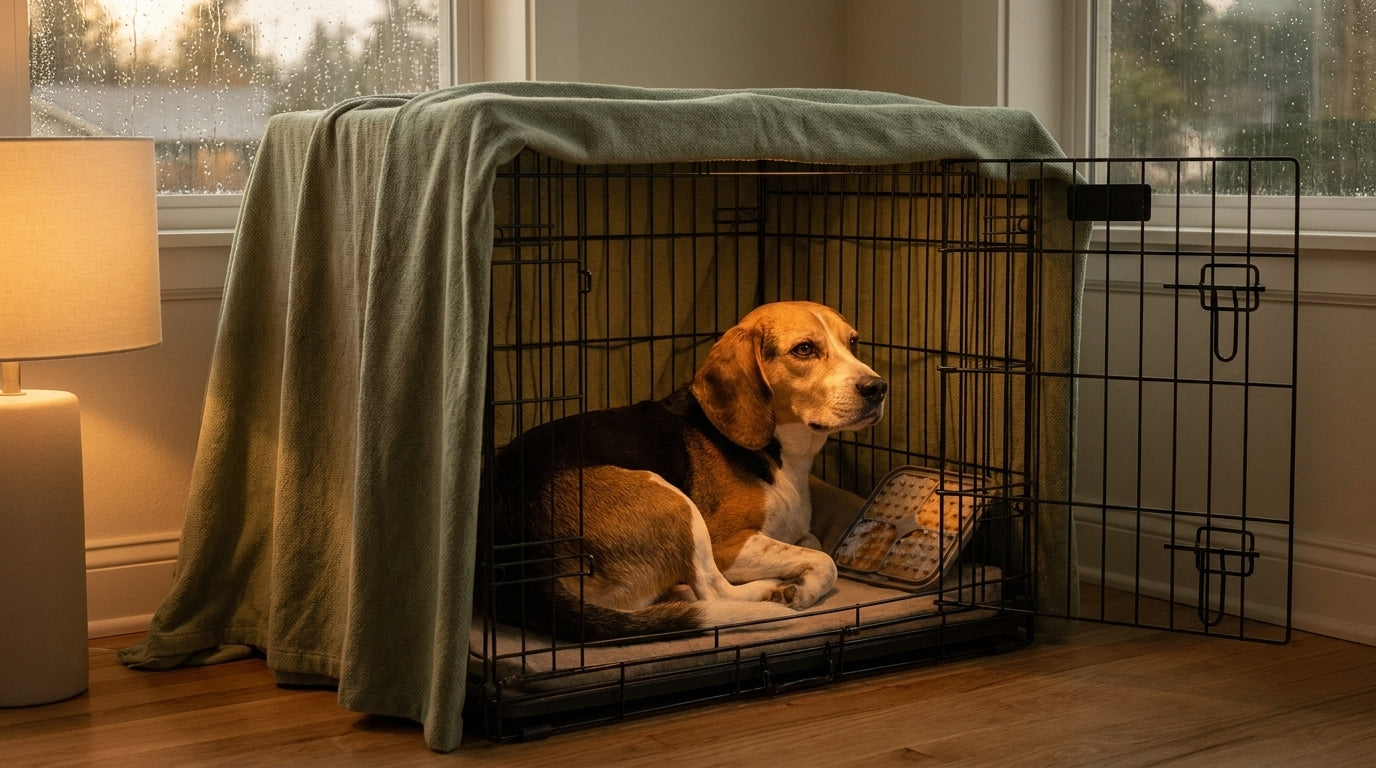
It starts about an hour before the storm arrives. She gets restless. She follows you from room to room. She refuses dinner. By the time the first thunder rolls in, her cortisol has already been climbing for sixty minutes and she has nowhere to put the dread. The next four hours will be the worst of her week.
Why dogs react to fireworks and thunder (the biology)

Storm and firework phobia is not psychological squeamishness. It is a sustained sympathetic activation triggered by sound, pressure, and (for storms) electrical-field shifts dogs detect well before humans do. Anticipatory cortisol climbs an hour before the audible event. The three interventions below are the evidence-backed acute responses, applied in tiers from environmental to pharmacological.

"Sound dampening (white noise machines, closed interior rooms), visual blocking (drawn shades, covered crate), and lick-mat or chew-based parasympathetic activation."
Reduces sensory load by 30 to 60 percent and engages the vagus nerve before sympathetic dominance locks in. Most effective when deployed 30 to 60 minutes before the storm or firework window starts.
AVSAB sound-aversion management guidelines, 2008

"Counter-conditioning (pairing low-volume storm sounds with food during off-season), graduated exposure, and systematic desensitization protocols."
Rewires the dog's emotional response to the trigger sound from threat to neutral. Slow work, measured in months. Strongest long-term effect of any non-pharmacological intervention when run consistently off-season.
Mills, Veterinary Clinics of North America, 2008

"Veterinary-prescribed situational medications (trazodone, alprazolam, gabapentin) for severe phobia or single high-stakes events."
Lowers the baseline sympathetic response so Tier 1 and Tier 2 tools can actually work. Reserved for severe cases or predictable high-stakes events (Fourth of July, New Year's Eve). Vet sign-off required.
Overall, Clinical Behavioral Medicine, 2013
The 21-day off-season desensitization protocol
Acute storm management gets you through the night. Off-season desensitization changes what storms feel like the next year. The 21-day arc runs between thunderstorm seasons.
Low-volume exposure & pairing
Volume escalation
Realistic volume & generalization
What to do tonight if a storm is already incoming
You do not have 21 days. The storm starts in an hour. Run the acute protocol.
- Move the dog to an interior room. No windows. Closed door. Cover the crate or den-style enclosure. Reduces pressure-shift detection and visual triggers.
- Layer sound dampening. White noise machine, fan, calm music. Aim for steady masking volume, not silence (silence amplifies sudden thunder).
- Deploy the lick pad 30 to 60 minutes before the predicted start. Frozen yogurt or wet food. Parasympathetic activation works only if it starts before sympathetic dominance.
- If situational medication is on hand, give per vet instructions. Trazodone and gabapentin work best when dosed 60 to 90 minutes before the trigger.
- Stay calm and predictable. Match the dog's space, do not chase her into hiding spots, do not punish escape behavior. Your nervous system is part of her environment.
Acute management gets you through tonight. The 21-day protocol above is what changes the response pattern for next storm season.
Match the level to the response
| Level | What you see | Approach |
|---|---|---|
| Mild | Restlessness, panting, occasional vocalization. Recovers within an hour after event ends. | Environmental layer + lick mat. Off-season counter-conditioning starting in spring. |
| Moderate | Panting, drooling, hiding, refused food. Takes hours to recover. Sleep disrupted that night. | Environmental + behavioral layers. 21-day Anxiety Toolkit protocol starting at least 8 weeks before storm season. |
| Severe | Panic, possible bathroom accidents, attempts to escape, prolonged shaking, complete behavioral collapse. | Pharmaceutical layer with vet coordination, plus environmental layer. Behavioral work begins after stabilization. |
Frequently asked questions
Why are dogs afraid of thunderstorms?
Sensory overwhelm across multiple channels: sound (frequencies humans cannot hear), pressure (barometric drops), electrical (static buildup), even smell (ozone). The fear is the body's reasonable response to overwhelming, sustained sensory input.
What can I give my dog for fireworks anxiety?
For mild cases, parasympathetic activation tools (frozen lick mats) work for many dogs when used preventively. For moderate cases, pheromone diffusers and supplements (L-theanine, alpha-casozepine) provide modest additional support. For severe cases, veterinary-prescribed situational medications (trazodone, gabapentin, alprazolam) are appropriate. Always consult a vet before any supplement or medication.
How do I keep my dog calm during fireworks?
Pre-event: close windows, draw curtains, activate white noise, prepare a frozen lick mat 60 minutes before. During: allow safe space access, stay calm yourself, offer the lick mat at the start. After: low-key return to routine.
Do thundershirts work?
For some dogs, yes. The pressure-garment effect produces a mild calming response in roughly 30 percent of dogs in trials. Worth trying. Not a primary tool. Use alongside environmental management, not instead of it.
Can I desensitize my dog to thunder?
Yes, in off-season. Sound recordings played at low volume, paired with food, with gradual volume increases across 8 to 16 weeks. The Anxiety Toolkit eBook provides the week-by-week protocol.
Should I sedate my dog during fireworks?
"Sedate" is the wrong frame. For severe cases, veterinary-prescribed anxiolytics reduce panic to a manageable level. This is not the same as sedation, which can leave a dog aware of the fear but unable to act on it (a clinically worse state). Discuss specific protocols with your vet, not over-the-counter solutions.