
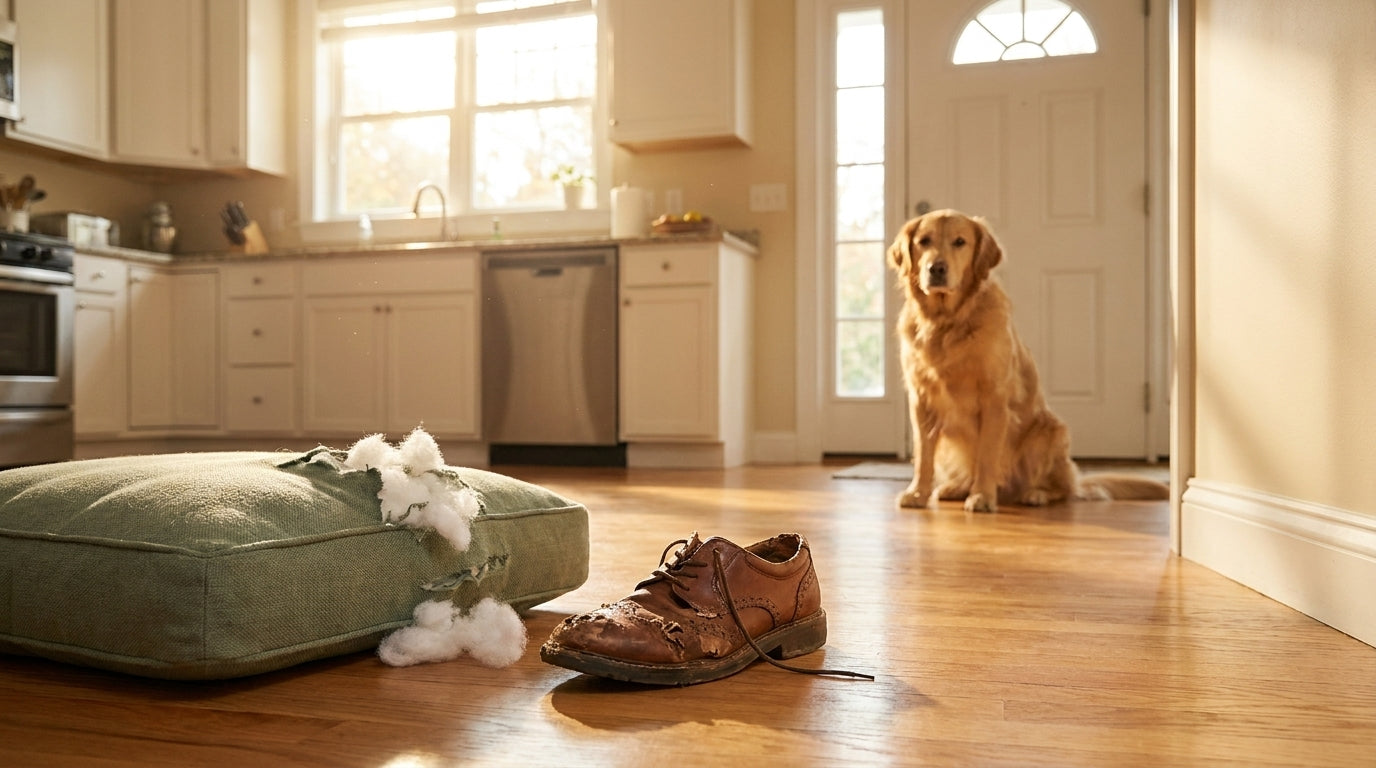
You come home. The chewed shoe is in the kitchen. The couch cushion has a hole. You think she is angry, or being spiteful, or making a point. She is not. She is showing you, in the only way she has, that being alone for the last six hours has felt like an emergency.
What separation anxiety actually is (and how it differs from boredom)

Separation anxiety is a panic response, not a behavior problem. The dog's autonomic nervous system reads departure as threat, cortisol spikes within minutes, and the destruction or vocalization that follows is the body's way of discharging a physiological state. Telling the two apart matters: boredom destruction responds to enrichment, panic destruction needs systematic desensitization. The three mistakes below sabotage the recovery before it can start.

"Long, emotional reunions. Greeting the dog enthusiastically, apologizing for being gone, building the arrival into the highlight of her day."
Reinforces the contrast between absence and presence. The bigger the reunion, the more catastrophic absence feels. Calm hellos and goodbyes flatten the emotional cliff and reduce anticipatory anxiety.
American Veterinary Society of Animal Behavior, 2017

"Punishing destruction, scolding for accidents, expressing frustration about damage when the owner returns."
Punishment delivered after the fact does not link to the behavior. It links to the return itself, raising anticipatory anxiety around departures. The destruction is a symptom of panic, not defiance.
Overall, Clinical Behavioral Medicine, 2013

"Irregular leaving patterns, varying the routine to "see what works," abandoning the protocol when progress feels slow."
Desensitization is duration-dependent. Inconsistent absences keep the dog at threshold instead of below it. Recovery requires predictable, graduated exposure, not random testing.
Sherman & Mills, Veterinary Clinics, 2008
The 21-day desensitization protocol
The science is settled. Graduated exposure below threshold is what resolves separation anxiety. The 21-day arc takes the dog from one-second absences to comfortable hours alone.
Sub-threshold absences
Extended absences with cues
Normalized departures
When to add medication support
Behavioral protocols carry most cases. A subset needs medication-assisted desensitization to stay below threshold.
- Severe baseline anxiety. The dog cannot tolerate even a 5-second absence without panic. Daily medication (fluoxetine, clomipramine) lowers the baseline so desensitization can start.
- Predictable high-stakes departures. Work trips, weddings, hospital visits. Situational medication (trazodone, gabapentin) carries the dog through specific events.
- Plateau at week 3. Behavioral progress stalled. Medication can re-open the desensitization window when willpower alone is not enough.
- Self-injury or extended appetite loss. Vet intervention takes priority. Behavioral work resumes once the acute physiology is stable.
For all four, the medication is a bridge, not a destination. Behavioral protocol runs concurrently. Most dogs taper off medication once the new baseline holds.
How long does it take to see results?
| Severity | Timeline | What to expect |
|---|---|---|
| Mild | 7-14 days | Visible reduction in destructive behavior. Reunion behavior calmer. Sleep and appetite normalize. |
| Moderate | 21-42 days | Full protocol completion. Owner can leave for 30-60 minutes without distress signs. May require follow-up reinforcement. |
| Severe | 90+ days, with medication | Behavioral plan combined with prescribed medication. Veterinary behaviorist coordination. Recovery is real but slower. |
Frequently asked questions
What are the symptoms of separation anxiety in dogs?
Distress beginning within 30 minutes of departure, including physical signs (panting, drooling, urination, defecation) and behavioral signs (vocalization, destruction near exit points, attempted escape). Failure to settle even when alone-time enrichment is provided.
How do you fix separation anxiety in dogs?
With a graduated desensitization protocol: pre-departure cue desensitization, sub-threshold absences (starting at 30 seconds), and gradual duration extension. Paired with parasympathetic activation tools and environmental management. For severe cases, veterinary-prescribed medication accelerates the process.
How long does it take to fix separation anxiety?
Mild cases: 7 to 14 days. Moderate: 21 to 42 days. Severe: 90 days or longer, typically with medication support. The protocol fails when owners skip duration steps, so timeline depends on consistency.
Can separation anxiety be cured?
"Cured" is the wrong frame. Resolved is closer. The dog learns to handle absences without distress, but the underlying predisposition may always remain. Most dogs maintain the resolution if the protocol's principles (calm departures, consistent routine) are maintained.
What triggers separation anxiety in dogs?
Common triggers: a move, a change in household composition, a hospitalization, the death or rehoming of another pet, owner schedule changes. Genetic predisposition also plays a role. Some breeds (working breeds, rescue dogs with histories of abandonment) are statistically more prone.
Will leaving the TV on help my dog with separation anxiety?
Sound dampening helps mildly anxious dogs by masking external triggers (cars, voices, the neighbor's dog). It does not address the underlying separation pattern. Useful as one component of environmental management, not as a primary intervention.