
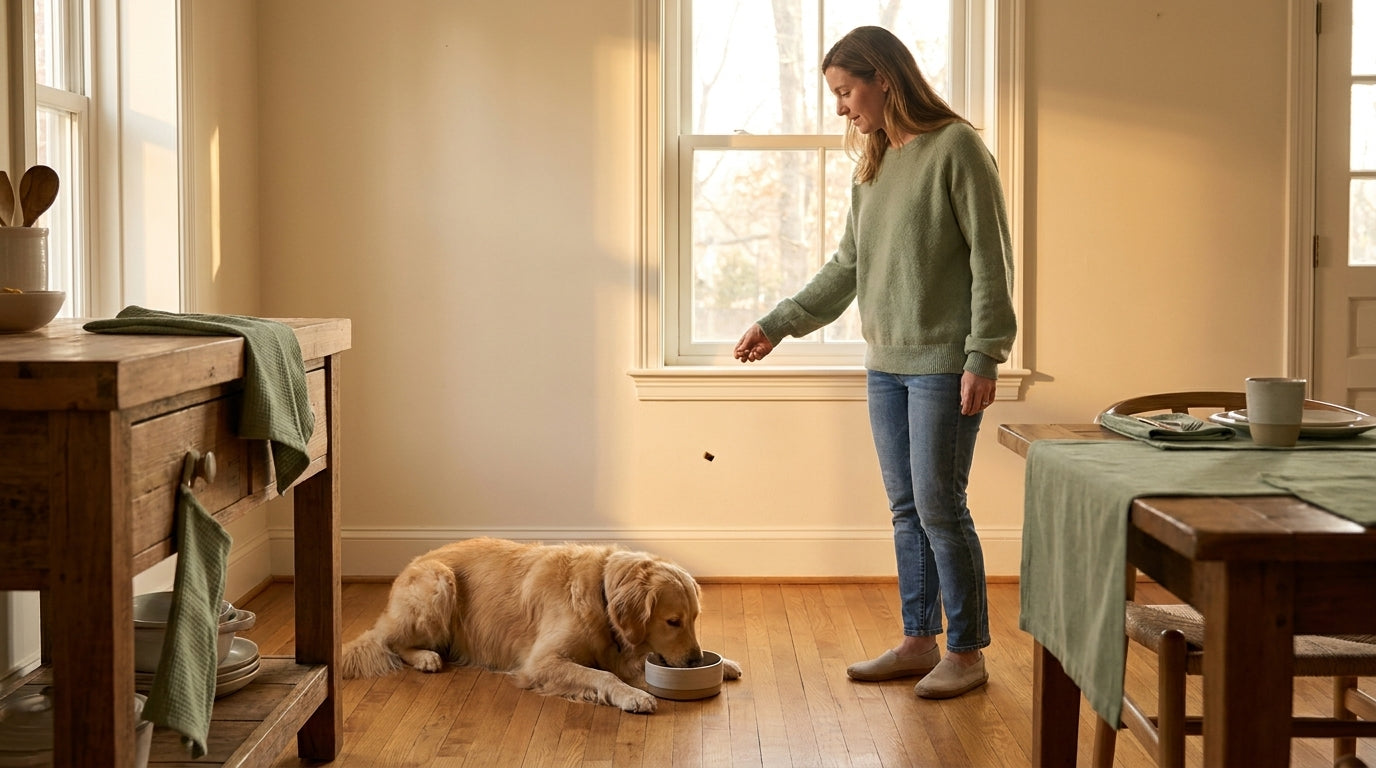
You walk past the bowl while she is eating. Her body stiffens. She does not look up. Her eyes shift toward you while her head stays down. The growl is so quiet you almost miss it. You step back. She continues eating. You think: she has never done this before. You think: should I do something?
What food aggression actually is

Food aggression is a form of resource guarding. It is normal canine behavior, not a moral failing of the dog. Severity ranges along a clear gradient, and the right response depends on the level you are seeing. Misreading the level is what most household incidents trace back to.

"Body stiffening near food, faster eating when approached, possible side-eye toward approaching humans or dogs. No vocalization, no overt threat displays. The dog wants to be left alone with the food but is not actively defending it."
You can walk past the bowl without incident, though the dog tracks your movement. May eat faster when you enter the room. Common, manageable at home with counter-conditioning, and almost never escalates if handled appropriately.
Donaldson, Mine!, 2002

"Audible growling, lip lifting, hard stares, freezing over food when approached. Body is tense. The dog is signaling clearly: do not come closer. Most cases of 'my dog has food aggression' in popular discussion fall here."
The growl is the warning. Heeding it keeps the situation safe. Approaching despite the warning escalates risk. Responds well to counter-conditioning over 6 to 12 weeks if applied consistently. Owner education matters as much as the training.
Overall, Clinical Behavioral Medicine, 2013

"Snapping, lunging, or biting in defense of food. May include bites with no prior warning if previous warnings (mild growls, freezing) have been punished out of the dog. This is a safety issue requiring veterinary behaviorist involvement."
Bite incidents around food or other resources. Multiple household members at risk. Children especially vulnerable. Not an at-home training project. Professional behaviorist consultation, possible pharmacological support, household safety protocols required.
AVSAB position statement on resource guarding, 2018
The 21-day counter-conditioning protocol
For Level 1 and early Level 2, a structured at-home protocol changes the dog's emotional response over three weeks. Level 3 requires a behaviorist; this protocol does not apply.
Distance & deposit
Closing distance
Hand delivery
What makes food aggression worse
Three responses turn a manageable Level 1 into an escalating Level 2 or 3.
- Punishing the growl. The growl is information. Punishing it teaches the dog to skip the warning and go straight to the bite. Reactive dogs that bite without warning have often had their growls extinguished.
- Hand-in-bowl conditioning. Popular advice tells owners to "stick your hand in while she eats so she knows you can." This raises stress around food and accelerates guarding. Do the opposite: add value at a distance.
- Kids near food. Children below the age of 8 cannot read canine warning signals reliably. Manage the environment instead of training around it: bowl behind a baby gate, kids in another room during meals.
For Level 1 and Level 2 cases, the 21-day protocol does the work. For Level 3 (any bite history), the answer is a board-certified veterinary behaviorist, not a YouTube video.
Match the severity to the intervention
| Level | What you see | What to do |
|---|---|---|
| Mild (Level 1) | Body stiffening, faster eating when approached, side-eye | Counter-conditioning protocol at home. 4-6 week timeline. Slow feeder helps. |
| Moderate (Level 2) | Growling, lip lifting, freezing, hard stare | Counter-conditioning at home + slow feeder + separate feeding space. 8-12 week timeline. Consider video consultation with behaviorist. |
| Severe (Level 3) | Snapping, lunging, bite history | Veterinary behaviorist consultation now. Possible medication. Household safety protocols (children separate from feeding zones). Not an at-home only project. |
Frequently asked questions
Why is my dog suddenly aggressive when eating?
Sudden onset of food aggression in a dog that did not previously show it can have several causes: medical changes (pain, anxiety, hormonal shifts), recent environmental stressors, or an event that triggered the underlying pattern. Sudden onset specifically warrants a veterinary check before behavioral work, to rule out medical contributors.
Can food aggression in dogs be cured?
"Resolved" is more accurate than "cured." Mild and moderate cases resolve to the point where the behavior no longer occurs in normal household conditions, with consistent counter-conditioning. The underlying predisposition may remain, requiring lifelong management (no taking food away, no children near the bowl). Severe cases often manage rather than resolve completely.
Should I punish my dog for food aggression?
No. Punishment intensifies the behavior in clinical observation and increases bite risk. The dog perceives punishment as confirmation that food is at risk when humans are present. Counter-conditioning, which changes the dog's perception of human presence, is the evidence-based approach.
Why does my dog growl when I touch his food bowl?
Resource guarding. The dog is signaling that approach to the bowl is not welcome. The growl is the warning. Honoring it (stepping back) keeps the situation safe. Working through counter-conditioning over weeks changes the underlying perception so the warning is no longer needed.
Is food aggression dangerous?
At mild levels, manageable. At moderate levels, requires careful handling but rarely escalates to bite if approached correctly. At severe levels, yes, dangerous, especially to children. Bite incidents around food are among the most common dog bite contexts. Severity level determines risk and required intervention.
How long does it take to fix food aggression in dogs?
Mild cases: 4 to 6 weeks of consistent counter-conditioning. Moderate cases: 8 to 12 weeks. Severe cases: longer, with professional involvement, possibly with lifelong management rather than full resolution. The variable is consistency. Inconsistent application extends the timeline significantly.