
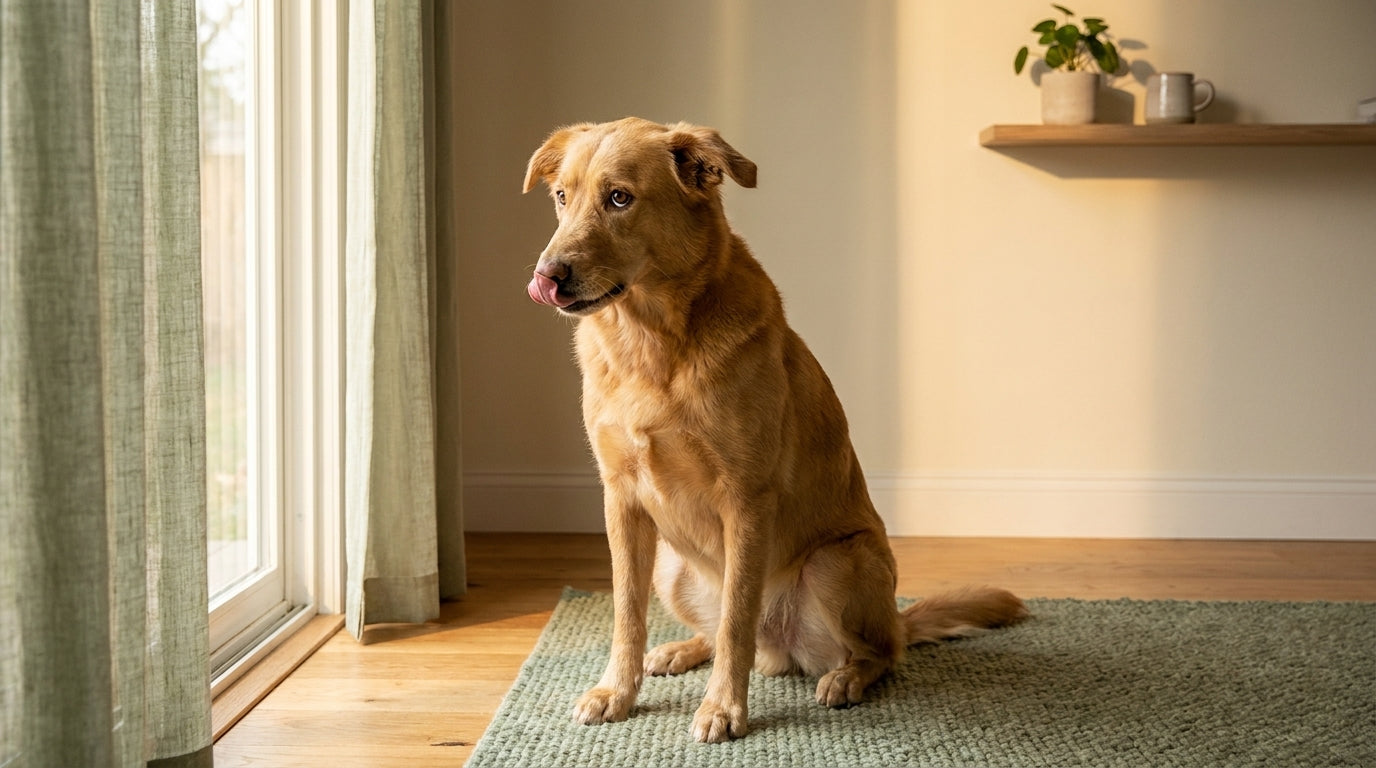
You think back to the past few weeks. The morning lip licking when there is no food in sight. The slow stretch of panting near the window on a perfectly cool afternoon. The way she eats her dinner with her body turned away from the door. None of it looks like a problem, until you put it in a list. Then it does.
How anxiety actually shows up (the biology behind the signs)

Anxiety expresses through the autonomic nervous system before it expresses through behavior. The signs you can see are downstream of elevated cortisol, sustained sympathetic activation, and disrupted vagal tone. They cluster into three tiers by severity: subtle calming signals, behavioral changes, and clinical-level patterns. Reading the tier tells you whether home protocols are enough or whether the dog needs veterinary support.

"Lip licking with no food, yawning out of context, shallow rapid panting at rest, sustained eye whites, pinned ears, low tail carriage."
Subtle calming signals. Sympathetic nervous system is mildly activated, dog is communicating stress through low-grade displacement behaviors. Reversible with environmental change and parasympathetic-engaging tools.
Mills & Levine, Veterinary Journal review, 2006

"Pacing, destructive chewing, hiding, excessive grooming, appetite changes, sleep disruption, hypervigilance at windows or doors."
Cortisol has been elevated long enough to drive behavior changes. Sympathetic dominance is now sustained, not transient. Behavioral protocols help, but the underlying trigger and environment need direct attention.
Sherman & Mills, Veterinary Clinics of North America, 2008

"Self-injury (paw chewing to the point of bleeding, tail chasing to wounds), prolonged appetite loss, aggression onset, fear-driven elimination, collapse-like shutdown."
Clinical-level anxiety. Self-care behaviors have crossed into self-harm. Home protocols are not enough. Veterinary or veterinary-behaviorist consultation is the next step, often with situational or daily medication.
Overall, Clinical Behavioral Medicine for Dogs and Cats, 2013
The 21-day observation & intervention arc
The signs above tell you what is happening. The next three weeks turn that information into an intervention.
Baseline mapping
Trigger response protocol
Evaluation & escalation
When anxiety crosses into vet territory
Some patterns are not home-protocol material. Book the vet when any of these show up.
- Self-injury behaviors. Paw chewing to the skin, tail chasing to wounds, lick granulomas, or any compulsive grooming that breaks the surface.
- Sustained appetite loss. More than 48 hours of refused meals in an otherwise healthy dog. Anxiety can suppress appetite into clinical territory.
- New-onset aggression. A previously social dog becoming fear-reactive toward family, strangers, or other dogs. This is a different kind of escalation than typical anxiety presentations.
- Complete shutdown. The dog stops engaging with food, play, owner attention, or environment for hours at a time. This is functional shutdown, not calm.
For each of these, the next step is professional. Behavioral medicine is real medicine. The intervention works faster and more reliably than what most owners can do alone.
When to escalate
| Severity | What you see | What to do |
|---|---|---|
| Watch | Occasional physical signs (lip licking, yawning out of context, panting at rest) appearing during specific triggers. Recovers fully between triggers. | Track for 14 days using the Anxiety Trigger Profile diagnostic. Start lick mat preventive sessions before known triggers. |
| Act | Daily physical signs plus behavioral symptoms (pacing, hiding, destruction). Appetite and sleep inconsistent. | Lick mat protocol + environmental management + counter-conditioning. If no improvement in 30 days, vet consultation about supportive medication. |
| Escalate | Self-injury, prolonged appetite loss, panic responses, social withdrawal, weight changes. | Veterinary behaviorist within 48 hours. This is not a category for at-home interventions alone. |
Frequently asked questions
How do I know if my dog has anxiety or is just being a dog?
Look for patterns, not individual behaviors. One bout of pacing is not anxiety. Pacing daily, especially in low-trigger contexts, is. Use the three-layer model: if you can identify physical signs at low volume combined with behavioral signs at moderate volume, that is anxiety.
What are the physical symptoms of anxiety in dogs?
The most reliable early signs are lip licking with no food, yawning out of context, panting at rest, and whale eye. Secondary signs include raised hackles, lowered tail set, ears pinned back, dilated pupils, and gastrointestinal changes.
Is my dog stressed or anxious?
The terms are often used interchangeably, but stress is the body's short-term response, anxiety is the same response sustained over time. A dog showing brief stress signs that resolve within an hour is stressed. A dog showing the same signs across days or in low-trigger contexts is anxious.
Can dogs have panic attacks?
Yes. Canine panic looks like dissociation, blank-eyed staring, sometimes bladder or bowel release, sometimes complete behavioral collapse. It is a veterinary urgency. Trazodone, gabapentin, or situational benzodiazepines are commonly prescribed for short-term management while behavioral work catches up.
Why does my dog yawn so much?
Context determines whether yawning is normal or stress-related. After a nap, normal. During car rides, vet visits, when guests arrive, or when the doorbell rings, it is most likely an anxiety yawn driven by autonomic activation.
When should I see a vet about my dog's anxiety?
Within 48 hours if you observe self-injury, prolonged appetite loss, panic responses, or social withdrawal. Within 30 days if behavioral interventions do not produce visible improvement. A veterinary behaviorist, when available, outperforms a general vet for anxiety-specific cases.