
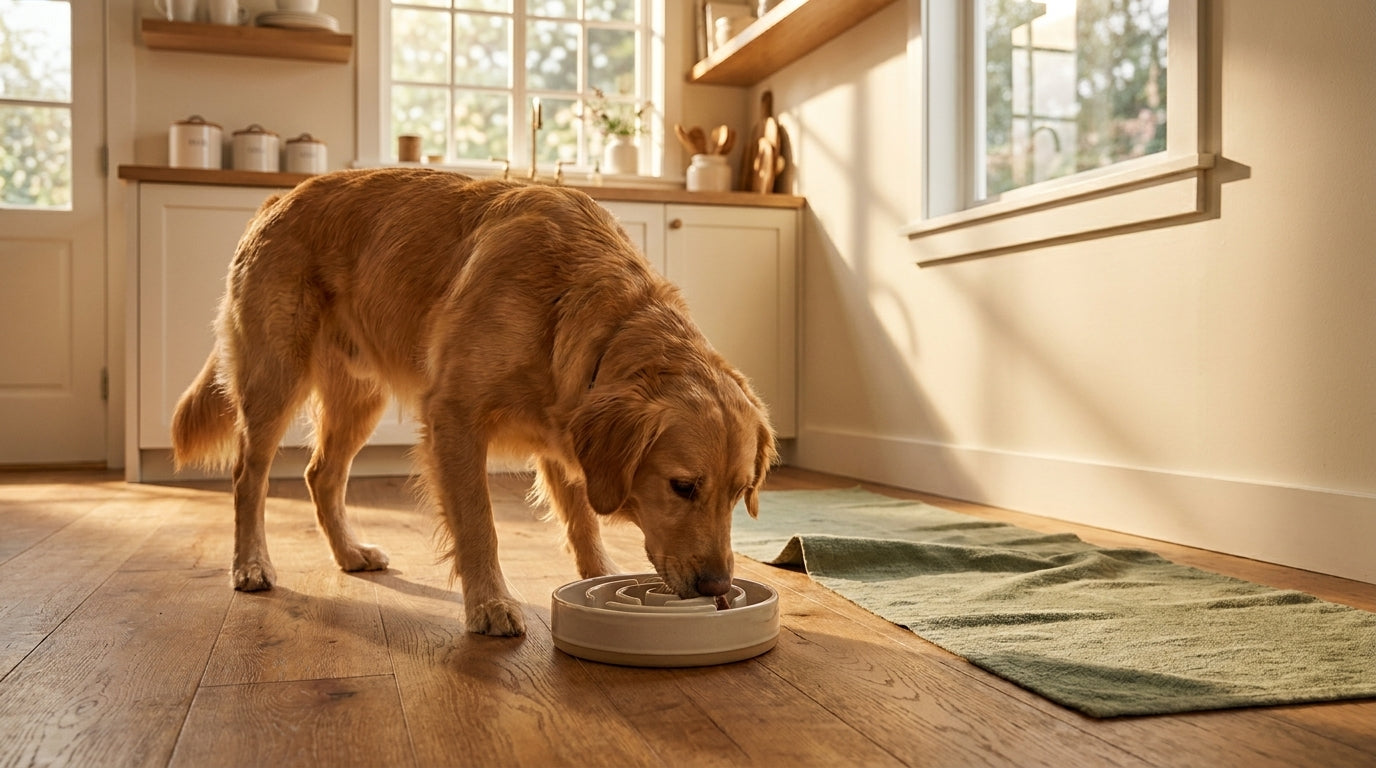
You search "slow feeder bowl" on a major retailer. You get 4,000 results. Some are $7. Some are $45. They all show smiling dogs. They all claim to slow eating by 5 to 10 times. None of them mention that half of them will not fit your dog's muzzle, or will slide across the kitchen floor on the first meal, or will be destroyed by a 60-pound retriever in week two.
The three slow feeder designs (and what each does well)

Slow feeders fall into three structural categories. Each slows eating through a different mechanism, and each fits a different kind of dog. Reading the differences tells you which one belongs on your kitchen floor.

"Flat-bottomed bowl with raised ridges in labyrinth patterns. Food sits in channels between the ridges; the dog navigates between them with the muzzle. Slowdown is motor-driven (physical navigation)."
Most dogs, most situations. Universal compatibility across muzzle shapes (with attention to ridge depth for flat-faced breeds). Easiest to clean. Most affordable category. The right starting point for first-time slow-feeder buyers.
Standard design across veterinary clinical use

"Bowl with movable parts (rotating discs, sliding compartments, lifting flaps). The dog must manipulate the parts to access food. Slowdown combines mechanical and cognitive load."
Medium to large dogs with high food motivation that solve maze designs too quickly. Adds mental engagement to the feeding ritual. Higher cleaning maintenance. Not suitable for very young, very old, or dexterity-limited dogs.
Effective for high-intensity eaters; documented in feeding behavior studies

"Raised bowl, often with maze elements integrated. Reduces neck flexion during eating. Designed for taller dogs or those with neck/spinal conditions."
Tall breeds with no GDV risk concern. Senior dogs with arthritis. Dogs with diagnosed cervical or spinal conditions. Not recommended for deep-chested breeds at risk for GDV (use flat-bottomed maze designs instead).
Glickman et al., 2000, noted elevated bowls associated with higher GDV risk in at-risk breeds
The 21-day slow-feeder transition protocol
A new slow feeder is not a same-day swap. The dog's pace, stomach, and food-arrival expectations all need to recalibrate together over three weeks.
Surface acclimation
Depth transition
Full protocol
Fit checks (the part most buyers skip)
The right design wrong-sized is worse than the wrong design right-sized.
- Muzzle clearance. The dog should reach the bottom of every channel without straining. For flat-faced breeds (Pugs, Bulldogs), shallower ridges are essential. Too-deep ridges cause the dog to give up.
- Bowl stability. Rubber-bottom or weighted base. A bowl that slides across the kitchen floor turns the meal into a chase scene and ends the slow-feeding effect.
- Material safety. Food-grade silicone, stainless steel, or BPA-free plastic. Avoid melamine and unmarked imports. The bowl gets chewed on, sometimes for years.
- Volume match. The bowl should hold one full meal portion with room to navigate, not be packed to the brim. Too-tight loading defeats the slow-feeder geometry.
The right slow feeder is the one your dog will actually use for years. Maze design for most, puzzle design for the high-intensity solvers, elevated design only when neck or back conditions require it. Then the transition protocol does the rest.
Which design fits your dog?
| Dog profile | Best design | Why |
|---|---|---|
| Most dogs, first slow feeder | Maze design | Universal fit, easiest to clean, lowest cost, fits most muzzle shapes |
| Very fast eater that solves maze quickly | Puzzle design | Adds cognitive load to mechanical resistance |
| Brachycephalic (pug, bulldog, French bulldog) | Maze with wide shallow ridges | Short muzzles struggle with deep narrow ridges |
| Senior dog with neck or spinal condition | Elevated design (if no GDV risk) | Reduces neck flexion |
| Deep-chested breed at risk for GDV | Flat-bottomed maze, never elevated | Elevated bowls linked to higher GDV risk |
Frequently asked questions
What is the best slow feeder bowl for dogs?
For most dogs, a flat-bottomed maze design in food-safe plastic or silicone with an anti-slip base. For very fast eaters that solve maze designs too quickly, a puzzle design with movable parts. Elevated designs only for dogs with no GDV risk who specifically benefit from raised feeding.
Are slow feeder bowls actually safe for dogs?
Yes, when made from food-safe materials and used appropriately. Look for BPA-free, PVC-free, and phthalate-free labeling. Inspect periodically for damage. The medical benefit (reduced air-swallowing, satiety signaling improvement, lower GDV risk in at-risk breeds) significantly outweighs any reasonable concern about the bowl itself.
Do slow feeder bowls work for puppies?
Yes, with size-appropriate selection. Use shallow ridges and wider channels for young puppies. Avoid puzzle designs with small movable parts until the puppy is mature enough to manipulate them without frustration (usually 6 months or older).
How long should it take my dog to eat from a slow feeder?
Most dogs eat from a properly-fitted slow feeder in 15 to 25 minutes. Under 5 minutes suggests the ridges are too far apart or the bowl is wrong for the dog. Over 40 minutes suggests too tight, producing frustration. The 15-25 minute window is the satiety-signaling sweet spot.
Can I use a slow feeder with wet food?
Yes, but with limitations. Wet food smears across the ridges and is less effective at slowing eating than dry kibble in maze designs. Silicone slow feeders are easier to clean with wet food than plastic. For wet-food-fed dogs, simpler designs (lick mats, separate bowls) often work better than maze feeders.
How do I clean a slow feeder bowl?
Most plastic and silicone slow feeders are dishwasher safe (top rack). For hand washing, use warm soapy water and a brush that can reach into the maze channels. Allow to dry completely between uses. Bacteria can grow in damp channels if put away wet. Replace if you notice persistent discoloration or smell that does not clear with cleaning.