
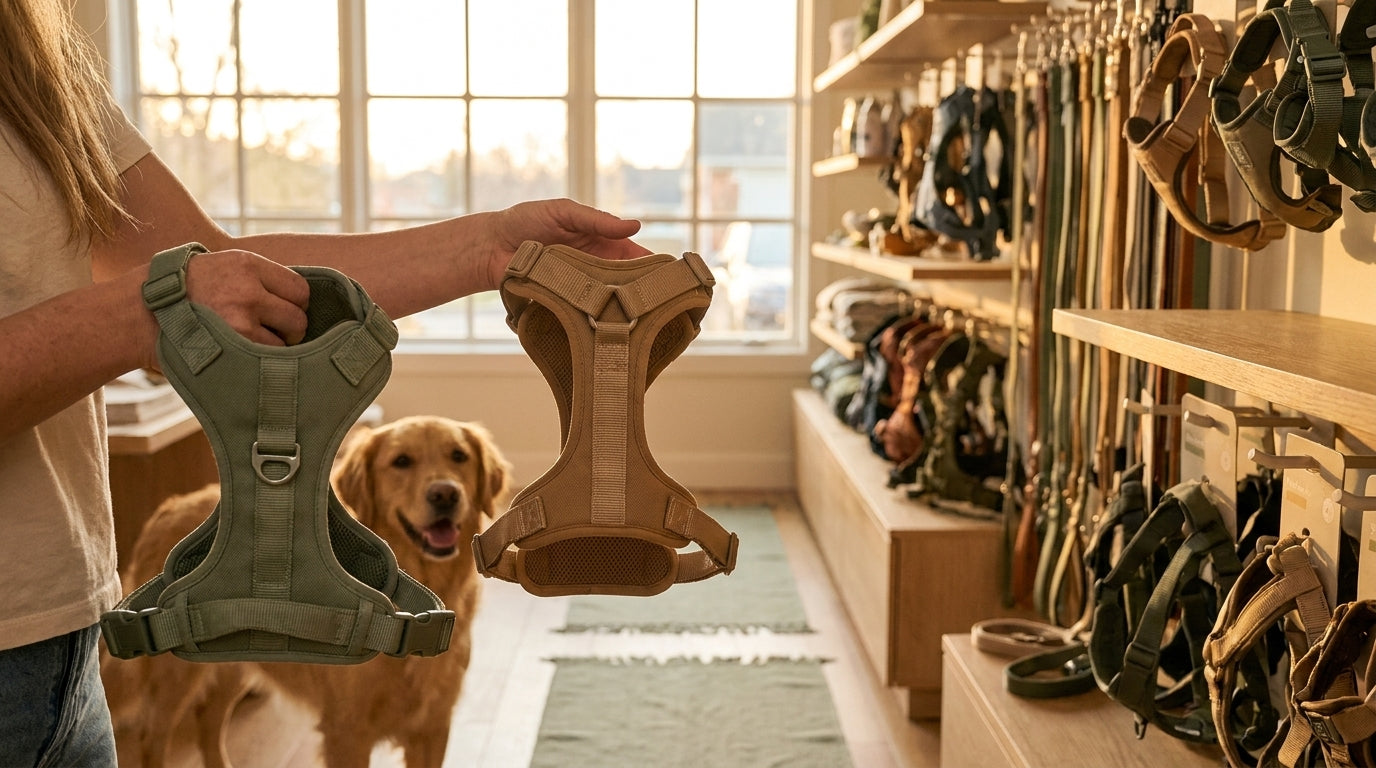
You are in the harness aisle. There are forty of them. They all claim to be no-pull. Six different colors. Three different price tiers. Inscrutable feature lists. You buy one. Two weeks later your dog is pulling exactly as hard as before. You return it and try another. The cycle is the problem.
Why most no-pull harnesses do not work

The phrase "no-pull" describes intent, not mechanism. Most harnesses on the wall use the back-clip configuration that comfortable for the dog but does nothing about the opposition reflex. The three configurations below are the ones with controlled-study evidence behind them. Reading the differences lets you skip the cycle.

"Chest-ring leash attachment. Forward pulling redirects into a sideways body turn through chest-mounted clip."
Front-clip mechanics break the opposition reflex by redirecting pull into a turn. Controlled trials show 60 to 80 percent reduction in sustained pulling within 14 days of consistent use. Best for handler-active walks.
McGreevy et al., Veterinary Behavior, 2018

"Figure-eight muzzle loop with chin-clip leash attachment. Pulling redirects the dog's head, gentleness depends on handler skill."
Head-halter mechanics give precise direction control. Effective for strong-pulling dogs the handler cannot physically out-muscle. Steep adaptation curve. Wrong technique can wrench the neck.
Hall et al., Animals, 2020

"Y-shaped chest strap conforming to sternum and clavicles. Preserves full shoulder range of motion. Dual-clip front and back."
Anatomically correct geometry. Front clip handles redirection during training mode, back clip works for established loose-leash dogs. Best long-term fit, smallest gait disruption.
Lafuente et al., Veterinary and Comparative Orthopaedics, 2019
The 21-day fitting & adaptation protocol
The harness arrives on Monday. The walk it actually fixes happens three weeks later. The arc moves from fitting to adaptation to loaded walks.
Fitting & positive pairing
Quiet-route walks
Loaded walks & triggers
Fit matters more than mechanism
The right harness wrong-fitted is worse than the wrong harness right-fitted.
- Two-finger gap at every strap. Tighter restricts breathing and gait. Looser allows the harness to twist and creates pressure points. Universal across every harness type.
- Chest strap clears the armpit. If the strap rubs the upper inside of the front legs, the dog will refuse to walk by week 2. Common fit failure on Y-front designs.
- Back strap sits behind the shoulder blades. If it crosses the shoulder, it restricts forward reach and the dog develops a shortened gait. Common on step-in designs.
- Re-check fit weekly. Harnesses settle after 5 to 7 wears. Coat thickness changes seasonally. A perfectly-fitted harness in winter can pinch in summer.
Most "the harness does not work" cases are fit cases, not mechanism cases. Two finger gap. Armpit clearance. Behind-shoulder back strap. Re-check weekly. Then the front clip and the technique do what they are supposed to.
Pick the harness type that fits your dog
| Dog profile | Best mechanism | Why |
|---|---|---|
| Impulsive puller (sudden lunges) | Front-clip + Y-front combo | Front-clip for triggers, Y-front for daily comfort |
| Steady puller (constant forward pressure) | Y-front + behavioral training | Front-clip loses effect on steady pullers within 2 weeks |
| Reactive panicker (large dog, panic responses) | Y-front daily, head halter for triggers | Head halter only after 2-4 week desensitization |
| Brachycephalic (pugs, bulldogs, French bulldogs) | Y-front only, never head halter | Muzzle pressure compromises restricted airways |
Frequently asked questions
What is the best harness for a dog that pulls?
For most dogs, a Y-front anatomical harness combined with behavioral training. For impulsive pullers specifically, add a front-clip ring for high-trigger walks. Head halters work for strong dogs with experienced handlers but require 2 to 4 weeks of desensitization before daily use.
Do no-pull harnesses really work?
Front-clip harnesses produce immediate partial reduction in pulling (60 to 80 percent in clinical observation). Y-front harnesses do not stop pulling by themselves; they make long-term training safer and more effective. The "instant no-pull" marketing claim is mostly accurate only for front-clip designs.
Are head halters cruel?
No, when introduced correctly. Used without desensitization, they produce stress, head-shaking, and walking aversion, which has led to the cruelty perception. Properly introduced over 2 to 4 weeks, they are well-tolerated and effective. They are specialty equipment, not a daily default.
Should I use a harness or a collar for walking?
For any dog that pulls, even occasionally, a harness. Collars apply pressure directly to the trachea, which causes measurable airway and cervical-spine stress at moderate pulling forces. Collars are appropriate for ID tags and brief leash use on dogs that walk on a loose leash.
Do harnesses stop dogs from pulling?
Front-clip harnesses reduce pulling mechanically. Y-front harnesses do not stop pulling; they protect the body while behavioral training resolves the pulling. Head halters provide the most control but require introduction. No harness replaces training. They make training possible and walks safer.
What size harness should I buy for my dog?
Measure chest girth at the widest point, just behind the front legs. Measure neck circumference at the base. Compare to the manufacturer size chart and choose the size where both measurements fall in the middle of the range, not at the upper or lower limit. When in doubt, size up for adjustability.